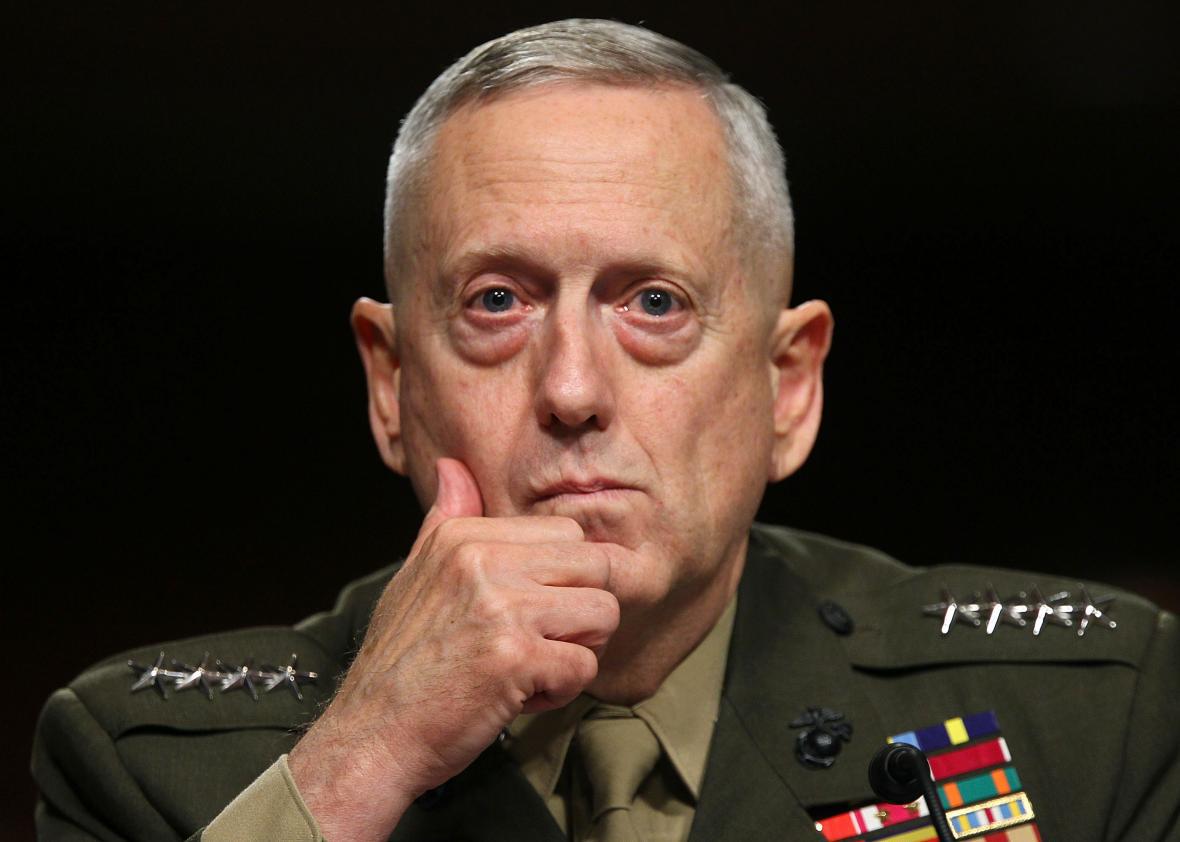
President-elect Donald Trump has reportedly chosen retired Gen. James Mattis as his secretary of defense nominee. In 2010, John Dickerson profiled Mattis for a series on risk-taking. The article is reprinted below.
Any risks—whether, for example, singing onstage, starting a company, or rock climbing —pale compared with the risks a soldier takes in combat. A soldier risks his own life, the lives of his comrades, and the lives of innocent civilians. An officer has this burden, and more, because he also makes the decision to risk the lives of his soldiers, knowing that some of them will come to harm.
Marine Gen. James Mattis, 59, has been making these decisions for almost 40 years since his graduation from Central Washington University. He led combat troops in the first Iraq invasion as a lieutenant colonel. He commanded Marines as a brigadier general in Afghanistan in 2001. In 2003 he was the Marines ground commander in Iraq, leading the 20,000 troops of the 1st Marine Division for 500 miles over 17 days, the longest sustained march in Marine Corps history. He returned to Iraq months later to direct the fight against insurgents in the raging Al-Anbar province. Now a four-star, Mattis is commander of U.S. Joint Forces Command. It’s his job to help the Army, Navy, Air Force, and Marines fight in coordination. He has also become a key figure in the debate over how the military should adapt to irregular warfare, the kind in which enemies hide in mosques or deploy computer viruses.
And Mattis has made a special study of risk. After returning from Iraq, he pushed to create the Marine Infantry Immersion Simulator. Built in an enormous former tomato-packing plant, the training course helps reduce the risk of friendly-fire accidents by re-creating the chaos of close-quarter combat. It also uses holograms to help Marines make the split-second decision between shooting an enemy turning the corner with a bomb and sparing the woman with a loaf of bread. In 2006, Mattis and Army Gen. David Petraeus led the push to write the Army/Marine Counterinsurgency Field Manual, which guides troops in Afghanistan and Iraq. The manual articulates a new concept of risk: Troops use less force and accept more short-term vulnerability to build ties with locals that will bring longer-term security.
Mattis is an evangelist for risk with two core principles. The first is that intellectual risk-taking will save the military bureaucracy from itself. Only by rewarding nonconformist innovators will the services develop solutions that match the threats conceived by an enemy that always adapts. The second is that technology cannot eliminate, and sometimes can’t even reduce, risk. Mattis warns about the limitations of sophisticated weapons and communications. They can be seductive, luring military planners into forgetting war’s unpredictable and risky nature, leaving troops vulnerable.
Fighting in Al-Anbar: Returning to History
If you’ve ever taken a big risk, this will sound familiar: As you approach the moment of decision, your heart spurs you on, but before you can act, your head gets in the way. You think, and you hesitate. You talk yourself out of starting that company or you lock up on the mountain you’re climbing. Maybe you’ve drawn a line down the middle of a piece of paper and listed pros on one side and cons on the other. (Or, like Hamlet, you’ve wandered the house muttering.) Finding the balance between your head and your heart determines the difference between a risk and a gamble: With a risk, you can survive if you fail. With a gamble, a loss is irrevocable.
Mattis embodies the risk-taker’s mix of head and heart. You can see it on the walls of his library. As one of nine combatant commanders, he was assigned the sprawling 17,000-square-foot Virginia House on Norfolk’s huge Navy base. Unmarried, Mattis lives alone (Warrior Monk is one of his many nicknames). Walking into his pristine house I felt like I needed an admission ticket until I got to the two well-used rooms off a back hallway. The library shelves are packed with histories and military manuals. In conversation, Mattis regularly gets up to retrieve a volume—to cite a passage about the insurgency in Algiers or show a table about fuel use in the initial sprint into Iraq.
The photographs that hang on the wall space not devoted to books testify to the less cerebral side of Mattis’ personality. One of his favorite photographs of many from his combat tours shows the men of the platoon he traveled with in Iraq. He did not command from a remote location as some generals do but made regular tours into the thick of the action. (In a five-month period in 2004, 17 of his platoon’s 29 members were killed or wounded.) In another photograph, he’s a young lieutenant in full combat gear, staring into the screaming mouth of his commanding officer. He is being chewed out for getting into a drunken bar fight the night before.
In Afghanistan, Mattis yelled at his driver for speeding through a village but complains that at home in the United States, Marine regulations force members of the corps to wear helmets when they ride motorcycles. He is not a barrel-chested Marine but of average build. In our discussions, he was easy to know and self-deprecating almost to a fault, attributing any battle success to the Marines and crediting most ideas to someone else. He was as much smart-ass as the hard-ass portrayed in HBO’s Generation Kill. Greeting an officer in the Royal Navy, he quipped, “celebrating another year of not being French.”
In the winter of 2003-04, the U.S. military needed any kind of solution in Al-Anbar province and turned to the Marines and Mattis. In the spring of 2003, Mattis, had led the 1st Marine Division into Iraq to start the war. Now he was being called back into some of the ugliest fighting of the entire campaign, against a growing insurgency setting roadside bombs and hiding in Iraqi National Guard and police uniforms. This experience would test and shape his views about risk, the limits of force, and the necessity of adapting quickly in the fiercest conditions. In the end, the strategy he developed for Al-Anbar would require two things: lethal force and an intellectual theory of restraint.
Mattis was at Camp Pendleton just north of San Diego when the call came to return to Al-Anbar. His first response was to turn to his library for a solution to the changing war in Iraq. What at first seems new becomes familiar by historical analogy. Instead of starting from scratch, he looked to apply the lessons of previous counterinsurgencies in Algeria, the Philippines, and Vietnam.
Among his key texts was the classic Marines 1940 Small Wars Manual which outlined principles for identifying and fighting an insurgency. The lessons in the reading were clear: The public was the prize. Win over the public and the insurgency loses its base of support. At the time, U.S. forces were locked in a brutal struggle that was alienating Iraqis. The more doors that were kicked in and houses reduced to rubble, the stronger the insurgency grew.
Mattis assigned his officers hundreds of pages of reading, which included news articles about mistakes the Israelis had committed in Lebanon, several accounts of shootings of civilians in Iraq, and T.E. Lawrence’s “27 Articles” about fighting in Arabia. The readings offered two lessons about risk. The first was that the risks of using too much force were greater sometimes than using no force at all. In a struggle to win over the population, collateral damage creates new insurgents with lifetime grudges, creates sympathy in the local population for anyone wanting to hurt Americans, and limits the useful flow of intelligence from potentially sympathetic Iraqis. The second lesson was that in a war for the population, helping restore electrical power or even handing out water can lower the risk of violence more in the long run than rolling tanks down the street.
As his division prepared to ship out, Mattis called in experts in Arab culture to lead cultural sensitivity classes. As Thomas E. Ricks recounts in Fiasco, Marines were taught to remove their sunglasses when talking to Iraqis, and when searching a home, to respect the head of the household by seeking his permission to enter rather than roughing him up. When Mattis led the 1st Marine Division into Iraq in 2003, he had insisted everyone shave as military decorum dictates (and because intelligence reports suggested Iraqis might try to pass themselves off as U.S. forces). Now just months later, he wanted his men to grow mustaches to look more like the people they were working with.
When Mattis had led the first attack on Iraq, his focus was on quick overwhelming force. When he judged a colonel was not taking enough risks, he took the extraordinary step of relieving him of his command. Now he was asking for the same risk taking but at a different pace. When Mattis wrote to his troops before they launched their campaign into Al-Anbar and told them their primary order was “First do no harm.” In dealing with insurgents Mattis pushed his Marines to strive to delay hostilities. “Stay friendly one more month, one more week, one more minute.” Through restraint and enemy over-reach, the Marines would slowly gain credibility with the locals.
Once the hard-core enemy was identified, they were to be killed as precisely and swiftly as possible. To emphasize the special treatment for this intractable constituency, Mattis changed the rules of engagement before going into Fallujah from “capture or kill” to “kill or capture.” He put the emphasis on eradication to make it clear to the aggressive Marines that in the battle for Al-Anbar they were being asked to apply their ferocity more exactly, not give it up altogether.
For Mattis, the teaching didn’t stop once the Marines got to the fight. He constantly toured the battlefield to tell stories of Marines who were able to show discretion and cultural sensitivity in moments of high pressure—the Marines who greeted an Iraqi funeral by clearing the street and removing their helmets, or the ones who diffused a street protest by handing out water rather than raising their rifles. He told of a platoon attacked by insurgents in Al-Anbar who, after suffering brutal losses, showed kindness to the civilians caught in the crossfire. “They had just finished scraping up their buddies off the deck but showed the people respect,” he says. “Those were Marines the enemy didn’t succeed in turning into racists who hated everyone.” In other words, Mattis called on his troops to accept more immediate risks—to not shoot, to remove helmets—in order to plant seeds for future peace.
Al-Anbar turned out to be a bad laboratory for Mattis’ experiment. In March of 2004, not long after Mattis took control, four military contractors from Blackwater were killed in Fallujah and their burned bodies were hung from a bridge. In response to the attack, the Marines were ordered to wipe out the insurgents with a heavy show of force. Mattis told his superiors they were insane to call for such a massive response. The Blackwater killers could be found and killed precisely and in keeping with his strategy. But he followed orders and led the attack (which was then cut short when political leaders lost their nerve).
Still, even at the end of the heaviest fighting, Mattis met with sheiks to continue the effort to win over the locals. He left Iraq in August of 2004, but the Marines continued to repeat his mantra: “First, do no harm.” Two years later, after the province almost slipped out of control completely, the “Anbar Awakening” reduced violence in the province, damaged al-Qaida in Iraq, and turned the war.
“Every Attempt To Make War Easy and Safe Will Result in Humiliation and Disaster”
The lessons of Al-Anbar have shaped Mattis’ current views not only about the risks Marines and soldiers must take as they fight block by block but also about how the military views risk in its approach to overall warfare. The core lesson is one he was already preaching: War will always be messy. You can hope to control it, but in the end it is unmanageable. This means always accepting extremely high levels of risk.
Mattis believes that some military and political leaders strayed from this fundamental fact in confronting the Iraqi insurgency. They assumed the new threat could be fought with modern approaches that were not as grueling and painstaking as the counterinsurgency. “The historic lessons were there,” he says of the Al-Anbar campaign. “We just tried to apply them to the current situation rather than ignore them and go with the American way of war, which is: Let’s hold our breath and pick up our laundry on Wednesday, get a haircut Friday, and get the tanks lined up to attack similar weapons systems.”
The public and politicians favor minimal casualties; less collateral damage; and short, winnable wars. This leads to a focus on technological solutions and away from seeing war as a long slog determined by human qualities of intuition, courage, and bravery. “A major attraction of [technology-dependent] war is that few Americans will be at risk,” writes military analyst Colin Gray. “The problem is that such a technology-dependent, standoff style is not appropriate for the conduct of war against irregulars.”
Drone attacks and PowerPoint presentations give the illusion that war is more manageable than it is, argues Mattis, which is why, as he works to prepare the military for wars of the future, he abolished Effects-Based Operations, a method of planning that sought to determine actions based on quantifiable outcomes. “It is not scientifically possible to accurately predict the outcome of an action,” says Mattis in explaining his decision. “To suggest otherwise runs contrary to historical experience and the nature of war.”
In making this case, Mattis sounds like the economists who warned against the use of financial instruments like Value-at-risk measurements that sought to quantify risk and make it precise. He quotes Sherman: “Every attempt to make war easy and safe will result in humiliation and disaster,” but he could just as easily quote Nobel Laureate economist Kenneth Arrow, who warned of the same problem in economics: “vast ills have followed a belief in certainty.”
If you’re constantly trying to make war more precise and predictable, you’ll promote people who thrive in squeezing out the marginal drop of uncertainty. If you recognize war’s essential messiness and the enemy’s adaptability, you’ll reward mavericks, risk-takers, and people who thrive in uncertainty. They’ll have the innovative reflexes necessary for a war that changes block by block, where one minute you may get a handshake and the next you may get a hand-grenade. “Some people feel affronted when something they thought to be true doesn’t happen,” says Mattis. “If that’s the case, then your sense of risk is much higher, and that leads to risk aversion. You need to be able to be comfortable in uncertainty.”
Speaking to a new crop of one-star generals, Mattis encourages them not only to take risks by challenging military doctrine but to protect the oddballs in their command. “Take the mavericks in your service, the ones that wear rumpled uniforms and look like a bag of mud but whose ideas are so offsetting that they actually upset the people in the bureaucracy. One of your primary jobs is to take the risk and protect these people, because if they are not nurtured in your service, the enemy will bring their contrary ideas to you.”
Counterinsurgency: Inviting More Risk
Only by accepting a higher baseline of risk could the military embrace the counterinsurgency doctrine that is now guiding soldiers on the ground in Afghanistan and Iraq. Fighting an insurgency asks troops to expose themselves to increased threats to their personal safety in order to win over the population, which decreases the long-term risk. The strategy as outlined in the manual (which includes Mattis’ Al-Anbar campaign as a key teaching point) is designed around several paradoxes about risk:
- Sometimes the more you protect your force, the less secure you may be.
- Sometimes the more force is used, the less effective it is.
- The more successful the counterinsurgency is, the less force can be used and the more risk must be accepted.
- Sometimes, doing nothing is the best reaction.
If an insurgent fires on you and flees through a crowded marketplace, don’t shoot, soldiers and Marines are told. By returning fire, you might hit a civilian, and even if you do get the shooter, you show everyone watching that you are dangerous and indiscriminate.
Using less force is effective in winning the population and discouraging the insurgency only if the local Iraqis can see you using less of it. A commander who prefers to manage from a forward operating base and doesn’t engage with the leaders of each village keeps his troops (and himself) safe but doesn’t forge local connections with villages. This leaves an opportunity for insurgents to do so and emboldens the enemy, because they think their adversaries are afraid to take them on.
Gen. Stanley McChrystal, the commander of coalition forces in Afghanistan, walks the streets without body armor. He explained why in his report to President Obama last August: “When ISAF [Internation Security Assistance Forces] travel through even the most secure areas of Afghanistan firmly ensconced in armored vehicles with body armor and turrets manned, they convey a sense of high risk and fear to the population. ISAF cannot expect unarmed Afghans to feel secure before heavily armed ISAF forces do. ISAF cannot succeed if it is unwilling to share risk, at least equally, with the people. In fact, once the risk is shared, effective force protection will come from the people, and the overall risk can actually be reduced by operating differently. The more coalition forces are seen and known by the local population, the more their threat will be reduced.”
This is why Mattis used to yell at his drivers to slow down when he traveled through Afghanistan. “I want to drive through here in a manner that gets me invited back,” he explains. Driving slowly is riskier, but it also sends two messages: The Americans are not afraid, and they are respectful.
Downgrading the use of force and accepting more risk is a departure from the military approach—ascribed to everyone from Carl von Clauswitz to Colin Powell—that victory can only come from total and overwhelming force. As Sarah Sewall, the author of the foreword to the public version of the COIN [Counterinsurgency Field] Manual writes in Military Review: “American culture and U.S. military doctrine prefer a technological solution and the overwhelmingly decisive blow.”
Asking troops to practice this kind of restraint and accept greater risk by reducing force is also at odds with human nature. Keeping your head engaged with a whole new set of calculations about cultural sensitivity is distracting when you’re trying to keep from getting killed. It’s also a challenge for brain chemistry, requiring your prefrontal cortex to control the adrenaline and fear reflexes blasting out of the primitive centers of the brain.
“For an 18-year-old it is an unnatural act in a firefight when someone is shooting at you to react calmly in the face of ultimate risk to their life,” says a lieutenant colonel who led a battalion for two tours in Afghanistan. When he took over the battalion the top noncommissioned officer told him he was lucky because in every squad there were men so battle hardened they’d “been black on ammo in a firefight.” (Green on ammo means you’re full, red means you’re dwindling and black means you’re empty.) They’d been empty and yet they’d prevailed. That was certainly an asset, but it was also a complication. “As far as counterinsurgency is concerned,” he says, “the toughest thing is that we’ve got guys in the squad who think going black on ammo is the solution.”
Addressing this challenge, argues Mattis, requires two fundamentals. The first is a tested and engaged set of officers. To teach troops how to take the risk of restraint first requires winning their loyalty and admiration, he argues. Only then can the “trust and connection” happen that allows the message to get through.
Mattis had standing with his troops because he led from the front, which means he took his own “jump platoon” into convoys where it was regularly attacked and hit by improvised explosive devices. According to one account, when the Iraqi-led Fallujah Brigade was created, Mattis decided it needed a test run to see if the native force could actually keep order in the city after weeks of fighting. He sent a Marine convoy through town to see if it would be shot at. He was in the convoy. (It got through without incident.)
In another instance, on his way back to headquarters he came upon a company that had just been ambushed. He sent the wounded on and turned his platoon into the fight. He was preaching restraint, but when the time came for fighting, he was willing to take the same combat risks he was asking his men to take. “That story was repeated in the chow line before he even came back,” says Maj. Andrew Petrucci, who served two tours under Mattis.
Officers need that connection with their troops because counterinsurgency’s call for increased risk undermines the relationship between officers and the men they lead. The younger officers don’t think the generals understand what it’s like to walk the streets not knowing who is trying to kill you and who isn’t. “You have to find a way to put it to them so that they don’t think you’re some fat cat general saying ‘hey risk yourself and put the women and children first and the enemy gets a bye,’ ” says Mattis.
The second fundamental necessity for counterinsurgency is ferocity. It is a paradox: To be restrained, you must be willing to be ferocious. Ferocity gives soldiers and Marines the confidence to accept more risk. If soldiers are certain they can be ferocious when the time comes, it will make them less jumpy when they are accepting the increased personal risks of leaving a protected base to engage with the locals or dropping body armor while they walk through town. Ferocity makes a unit feel more comfortable knowing they can fight their way out of a situation if necessary.
“We have an overweening sensitivity to the slaughtering of our enemies,” says Mattis. “I’ve put medals on Marines who have killed guys at 700 yards. And I’ve come right out and said it: ‘That was a beautiful shot.’ You must reward the kind of behavior that you want.” This sentiment got Mattis into trouble in 2005 when he said, in some cases it was “fun to shoot some people.” He has also been battered by public sensitivity over his handling of the 2005 killing of 24 Iraqis in Haditha. Liberals think he was too soft on the Marines involved. Conservatives think he bowed to political pressure and was too harsh on them.
Maintaining this culture of ferocity is why Mattis bristles about excessive hand-wringing over Marines who might want to ride without motorcycle helmets. Marines need to be risk-takers. That’s why the corps advertises at extreme sporting events. Ferocity is part of what the corps works to build in boot camp, and it is central to its storied history and traditions. If that’s the kind of spirit you need to fight wars, then you have to accept that the kind of person you want is going to sometimes ride at 120 miles an hour on a bike and hurt himself. “It’s not that I’m trying to extol this kind of behavior,” says Mattis, “but you have to have people who know that risk-taking sometimes means that people are going to get hurt. If you can’t accept that, if your view of warfare is always hurtful and you’re psychologically damaged by it, you start putting up guardrails.”
It might be easy to think Mattis is cavalier about the risks he asks his men to take. That was the charge when he relieved a colonel on the march into Baghdad who he thought was taking too few risks. In conversation he, like other Marines and soldiers, speaks about killing and death as civilians might talk about the weather. But he is not cavalier. He is obsessed with using simulators to train troops because he wants to reduce stupid deadly mistakes. It’s also why he is brutal about academics “who have never had to write a letter to the family of a dead Marine” and military planners who forget that it is 18-year-olds who will have to take the risks at the other end of their grand theories.
When asked to single out the thing that makes him risk averse, Mattis cites casualties. At times he has asked Navy doctors to assemble a field hospital from scratch while his battalion watches to reassure the troops they will get treated immediately if they get wounded. But Mattis asks his subordinates not to report casualties in the midst of battle.
Mattis believes in his mission and that freedom is at stake in the wars America fights. If it is his mission to engage in the fight, he has to know when to put death aside or it will keep him from doing his job. He won’t be able to take the risks he thinks are necessary to win, or the risks that might keep even more Marines from dying tomorrow.
Read the other profiles in this series, on rock climbers Eli Simon and Pete Fasoldt, entrepreneurs Redbeacon, the band Girlyman, and Marine Gen. James Mattis.
Become a fan of Slate and John Dickerson on Facebook. Follow us on Twitter.
