
Read more from Slate’s special issue on the future of food.
In 1995, Kraft expanded its line of packaged kids’ lunch combinations to include pizza-themed Lunchables despite negative reviews from parents who’d taste-tested the product. They found the application of cold pizza sauce, cold meat, and cold shredded cheese on cold crusts both unappetizing and incongruous with the steaming, oozy slices they associated with the word pizza. Within a year, though, sales of the portable, build-it-yourself lunches had reached $150 million, and pizza Lunchables accounted for a quarter of the Lunchable brand’s total volume. Last year, the brand’s dollar sales reached $569 million.
Mothers and fathers may have been surprised, even as they threw boxes of the stuff into their shopping carts under duress, but Kraft wasn’t. Unlike their parents, kids who had participated in trials during the product’s development loved both the idea of playing pizza chef and the taste of the meals.
Every children’s food manufacturer worth its salt knows that if the target market doesn’t love a product, it will languish on shelves. Numerous studies have shown that children, and even toddlers, exact increasing influence over a family’s food purchases. Researchers in Austria inconspicuously observed 178 parents shopping with their children and found that twice as many purchases in supermarkets were triggered by children than their parents are aware of. According to a report by market researcher Packaged Facts, kids between 3 and 11 years old collectively wielded $18 billion in purchasing power in 2005.
But how do food manufacturers conduct sensory research on preschoolers with difficulties focusing, or first-graders who are just coming to grips with reading—let alone babies and toddlers? By tailoring testing methodology to different groups of kids based on their age and abilities.
Unsurprisingly, it’s easiest to test foods on kids who are old enough to read and write about what they’re eating. For these children, ages 7 and older, researchers like those at Northland Sensory Insights, a consumer research facility in Northbrook, Ill., often use what are known formally as “verbal hedonic” scales, which incorporate age-appropriate language and are used in combination with pictorial scales (more on which below). About 25 years ago researchers conceived of the idea of using child-friendly colloquialisms on verbal hedonic scales, and a popular scale emerged in the late ’80s that included the phrases “super good” and super bad.” This scale has been mostly abandoned, since “super bad” can now have a very different meaning. Instead, Northland has forsaken efforts to sound hip and now uses the much more straightforward “dislike very much” and “like very much” on tests administered to elementary- and middle-school kids on computers.
What about kids who are too young to read? For these, the pictorial scale—the mainstay of kids’ sensory research—is used in isolation. Pictorial scales can be simple and stylized—a common choice is a five-point star scale not dissimilar from the star systems some restaurant and movie critics use. Since kids as young as kindergarteners are used to receiving stars for good behavior or tasks well-done at school, the meaning of the star scale is usually pretty clear to them.

Courtesy of The National Food Lab.
Another popular version is a more literal scale that relies on circular faces bearing expressions ranging from a face with a big open-mouthed smile with arched eyebrows (for “extreme liking”) to a straight-lined mouth (for “neither like nor dislike”) to an inverted smile (meaning “extreme dislike”).

Anne Goldman/ACCE.
Pictorial scales are a godsend for communicating with pre-literate children, but they also have drawbacks. Sometimes young children think that they are being asked which of the smiley faces best represents how they feel, not how much they like what they’re eating. (Also, the face for “extreme dislike” is interpreted by some to convey anger, which is confusing for children, most of whom don’t respond to even the yuckiest snacks with rage.) Some early versions of smiley faces included more features—different hairstyles, accessories, fleshed-out anatomical details—but kids found these peripheral features more engaging than the task of rating the food they were eating, so researchers toned down the add-ons. Cultural nuances also affect the usefulness of pictorial scales: Versions of the smiley-face scale that include tongues poking out—meant either as a sign that a food was lip-smackingly delicious or as an indication of disgust—have been deemed inappropriate for young product testers in Thailand and Malaysia, where it’s considered impolite to show your tongue.

Anne Goldman/ACCE.
One of the most creative pictorial scales ever developed is also, sadly, one of the least useful. In the 1980s, Bert Krieger, a researcher with a candy manufacturer, developed a scale with the Snoopy cartoon character in seven poses ranging from perky-eared ecstasy to droopy-eared disdain to elicit feedback from kids on recipe changes to chocolate bars. Snoopy only had a short run in testing circles, as children were both distracted and puzzled by his various incarnations.
Pictorial scales do a good job of eliciting reliable responses from kids who are old enough to understand what they mean, but companies have a tougher time gauging reactions to new products aimed at children who not only can’t read but whose cognitive abilities are nascent. For example, a child 5 or younger is limited by what psychologists call “centration,” which means he can consider only one attribute of a food at a time. A kindergartener can tell you his judgment of a food’s appearance, or of its texture, or of its flavor—but he can’t synthesize these aspects to tell you about the full sensory experience.
Researchers like Dawn Chapman, the sensory and data project manager at the National Food Lab, a consulting firm and consumer research facility in Livermore, Calif., sometimes engage preschoolers in one-on-one interviews to try to tease out their true feelings about a food. This approach can be costly for clients, however, since interviews are time and labor intensive compared with a scenario in which a large number of kids complete a test in a single sitting. Also, there’s a danger of false self-reporting. Though preschool-aged children are not known for their social graces, they sometimes withhold honest feedback if it contradicts their parents’ teachings on good manners or disapproval of junk food. “We reassure them as best we can with lots of smiles, inflections of the voice, and a welcoming environment that their real feelings are really what we want to hear,” says Chapman.
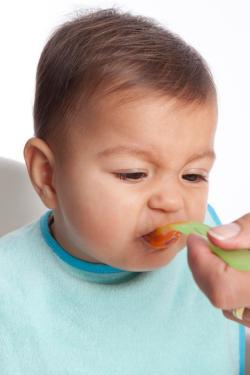
And what about the tightest-lipped, most cognitively challenged demographic of all? For infants and toddlers, sensory testing is often conducted at home, since such young children are most comfortable sitting in their own highchair or eating out of their regular bowl. (There’s also less chance of misinterpreting a baby’s rejection of a food as a sign of dislike when it’s really a sign of discomfort at being in an unfamiliar setting, surrounded by unfamiliar faces.) Researchers rely on mothers to read and translate their babies’ facial expressions and transcribe them to a seven- or nine-point scale that ranges from “extreme liking” to “extreme disliking.” Of course, the simplest test to determine whether a baby likes something is to note whether the food has been swallowed and ingested or spat out.
So what have sensory researchers learned from all the smiley faces, stars, and reports of “extreme dislike”? Parents will be unsurprised to hear that kids’ palates are very different from adults’. Whereas adults tend to appreciate complexity, depth of flavor, and textural contrast, young children steer toward more-singular taste profiles and soft foods. They notoriously find “bits” or particulates in their food off-putting, often rejecting chunky peanut butter or jams with pieces of fruit or pulpy orange juice. Still, kids are by no means without an adventurous spirit. Sensory research shows that inexplicably, children as young as 5 have an inordinately higher tolerance for intense sourness (consider the hugely popular Warheads Extreme Sour Candy) at levels that adults find virtually intolerable.
What about the cold pizza sauce that, as Kraft discovered, kids loved even though their parents abhorred it? One theory is that young children haven’t yet developed a point of view about temperature; rather, their preferences are mostly influenced by flavor and texture.
But there’s another explanation for why kids loved pizza Lunchables when adults didn’t. If there’s one overwhelming conclusion researchers have drawn from sensory testing about kids’ preferences, it’s that they’re crazy about sugar—a predilection that actually develops in utero. And it’s not just that kids like sweet, says Gary Beauchamp, the president and director of the Monell Chemical Senses Center; they crave it in much higher concentrations than adults do.
So it’s not just the adventure of constructing their own made-to-order (cold) pie that’s made countless kids beg their parents to send them to school with an Extra Cheesy Pizza Lunchable, including juice and Airheads candy, in tow. The combination box’s 28 grams of sugar (that’s nearly six teaspoons) probably has something to do with it, too.
Also in the special issue on food: five “food frontiers,” including technologies to make diet food tastier and fight salmonella; small-scale farmers decide whether to embrace automated agricultural equipment; the United States and Europe switch perspectives on GMOs; celebrating the inevitable decline of the cookbook; and the case for bringing back home ec. This project arises from Future Tense, a joint partnership of Slate, the New America Foundation, and Arizona State University.
