There have been plenty of great restaurant scenes on film. Think of Meg Ryan faking an orgasm at a Manhattan delicatessen in When Harry Met Sally, or Al Pacino shooting a rival gangster and crooked cop in a Bronx Italian in The Godfather, or even Jack Nicholson’s attempt to persuade an obstinate waitress to give him a side order of toast in Five Easy Pieces.
But for sheer belly laugh-inducing comedy, few can rival the lunchtime encounter between Dustin Hoffman and Sydney Pollack in the 1982 film Tootsie. Hoffman, playing a down-on-his-luck actor who has resorted to dressing as a middle-aged woman in an attempt to land roles, runs into his agent (Pollack) at the Russian Tea Room in Manhattan. He proceeds to flirt with him in a squeaky southern belle accent before revealing, in his gruff, normal voice, his true identity. A dumbfounded Pollack immediately orders a double vodka. “God, I begged you to get some therapy,” he says.
I am reminded of this scene while waiting for my own lunchtime meeting with Hoffman. The restaurant he has chosen is Culina at the Four Seasons in Beverly Hills, so, taking care not to prang the Bentley belonging to Hustler founder Larry Flynt, which is parked in front of the hotel in its usual spot, I leave my car with the parking attendant and head inside.
At the age of 74, the two-time Oscar-winning movie legend is starring in Luck, his first television drama. Produced by director Michael Mann, it is set in the horseracing world and is the latest small-screen epic from HBO. I arrive a few minutes early and wait in a suite reserved by HBO, where Mann and David Milch, the writer of Luck and of the acclaimed western series Deadwood, are also doing interviews today.
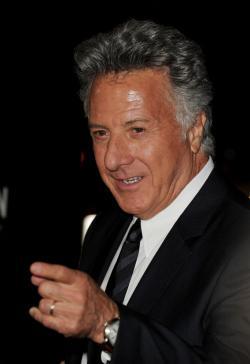
When Hoffman arrives, compact, tanned and smart in a dark suit and light blue shirt, silvery hair spiky and swept up, we head straight to the restaurant, past a vast and colourful floral display in the lobby. He moves slowly and deftly, charmingly fending off a fan keen to tell him about the time she saw him playing tennis. Then, after a brief moment of indecision about the table (“Is this one all right?” he asks, half-anxiously), we take our seats amid excited whispers from those around us: even the prosperous patrons of the Four Seasons are not above interrupting their lunch for a bit of star-spotting.
A waitress appears as I pick up the wine list and quietly cross my fingers that he will order alcohol (Lunch with the FT guests have, of late, been rather abstemious). To my great delight, he agrees to a tipple. Not wine, though. “It’ll make me sleepy,” he says to the waitress in his distinctive gravelly voice. “I’d rather have a Bloody Mary.” I choose a glass of Gavi.
Culina describes its food as “robust California-Italian” – this being Los Angeles, however, it also serves lots of sushi-inspired small “crudo” plates. We choose raw scallops, tuna and kampachi (Hawaiian amberjack) rolls, and I order a salad with prawns and lobster.
While we wait for our drinks, I tell him we have spoken briefly before, on the phone, about 18 months ago after he had shot the pilot for Luck. He furrows his brow, searching for a memory he can’t recall. Instead I ask him about the transition from film to TV; Hoffman made his name as an actor with trailblazing performances in The Graduate (1967) and Midnight Cowboy (1969), a period when film stars viewed TV roles with disdain.
“I was in the golden age of Hollywood but we didn’t know it was golden then,” he says. “The big studios were making films that are only being done outside the studio system today. It used to be you would never do TV.” That stigma has gone, he says; these days the only creative risks being taken are in low-budget independent films and on well-financed pay TV networks such as HBO. “They have money, so you’re not rushed to shoot 20 pages [of script] in a day, like you are with normal TV. HBO leave you alone and there’s no censorship. You do the work you want to do.”
The waitress has returned with our drinks and several crudo plates. “I expected a difference between TV and film,” Hoffman continues, after sipping his Bloody Mary. “But there wasn’t one, because we were working with film directors and we were only shooting three or four pages of the script a day.”
The series, which began airing in the US last month and starts in the UK on Sky Atlantic next weekend, revolves around a disparate group of jockeys, trainers, horse owners and gamblers connected to a racetrack in southern California. Luck has a strong film pedigree: the pilot episode was directed by Mann of Heat and Collateral fame. The tone, says Hoffman, was set by Mann, who produced the series, and the directors he enlisted for each episode. “He’s an actor’s dream … to get the authenticity that he wants, he asks you to go ‘under’, whereas a lot of directors might ask you to pull the wallpaper down.” I ask him to explain. “He wants the performance to be more like life,” he says. “Actors use the word ‘pushing’ … [but] going under means not pushing to hit a note.”
Hoffman’s compelling performance as Chester “Ace” Bernstein, a steely former bookmaker fresh out of prison, presented him with an unfamiliar challenge: playing a character over 12 episodes. “In the theatre, after the third week of rehearsal, you might say, ‘Eureka! I think I’ve found it.’ In the third week of making a movie, if you say, ‘Eureka!’, the director looks at you and says, ‘That’s nice but you have to match the first three weeks.’ You can’t change the character because you’re not shooting sequentially. With Luck, it’s evolving, we’re being led by what we did and we’re discarding what doesn’t work.” A second series has already been announced.
His film career, which began with his breakthrough role of Benjamin Braddock in The Graduate, almost never happened. “It was written for Robert Redford,” he recalls. “When you read the character in the book, he was blond-haired, good-looking, on the track team. I told Mike Nichols [the director], ‘I just don’t think I’m right for this.’ ” Even after Nichols persuaded him to take the role, the responses at early screenings were poor. “At every screening people were coming up to Larry Turman, the producer, saying, ‘It’s a shame, you had a great film here and you miscast the lead.’”
The Graduate, in which Hoffman’s character is seduced by an older woman, Anne Bancroft’s Mrs Robinson, went on to become one of the defining films of its era. But Hoffman says he didn’t particularly enjoy the experience – or the aftermath – and says he would have gone back to stage work had he not landed the part in Midnight Cowboy. “I was surprised at some of the vehemence of the reviews for The Graduate. Some of them I almost thought were veiled anti-Semitic remarks. You know, ‘Big nose’, ‘High nasal voice’, ‘How could you cast this funny-looking short Jew to play Benjamin Braddock, the ultra-Wasp?’ ” Nichols deserves credit, he says. “He went against casting … that was one of the points he was trying to make.”
By now my salad is almost finished and Hoffman has polished off several pieces of crudo. Our waitress appears and tells us she still has two plates left but Hoffman has had enough, so she brings them for me instead.
I ask if he has experienced anti-Semitism at other times in his career. He is quiet for a moment, thinking. “I don’t know if it’s a projection on my own part or reality … ” He is interrupted by the return of our server, who deposits more plates of scallops and tuna, before silently gliding away. He is quiet again. “I don’t know,” he says, after a while. “In a sense, a movie star represents a large segment of society because you want as many people as possible going to the theatre identifying with that person. There are six billion people in the world and 17 million are Jews, so you do the math. You can’t go wrong with Brad Pitt or George Clooney, but you might be gambling if you go another way.”
Most people think of Hoffman as a New Yorker but he was actually born, in 1937, in Los Angeles. His father was a furniture salesman and the family was constantly on the move. “The lower middle class was always looking upward,” Hoffman recalls. “He was a salesman, always trying to live above his standard of living. I lived in six different locations in the first 18 years of my life because he was always moving upward but falling short of the rent, so we’d have to move back to where we shouldn’t have left.”
Hoffman always felt a pull to New York, fuelled by seeing East Side Kids, a 1940s black-and-white movie serial about a ramshackle group of young boys from the Manhattan tenements. “When I used to see them on the Saturday matinee, that’s all I wanted to be,” he says.
His first trip to New York didn’t happen until 1958. “It took 13 hours on a propeller plane. I was about 20 and I remember I took a bus from the terminal to … ” Our waitress is at the table again, taking empty plates away. “I can put these there,” he says, picking up two rolls from his plate and transferring them to mine. “Don’t tell him I touched them with my fingers,” he says to the waitress, who giggles.
“Anyway, I got off the bus at Second Avenue and 34th Street and, in front of me across the street, there is a guy pissing on a bus tyre, in full view of everyone walking by. I remember my first thought,” he says, pausing for a moment. “And it was, ‘I’m home.’ I loved New York from then on.”
In 1970, Hoffman’s love survived a narrow escape from death when members of the radical leftwing movement Weather Underground accidentally blew themselves up with dynamite in the Greenwich Village house next door to his.
“I’m on the front page of The New York Times the next day, wearing a moustache that I’d grown for a film and carrying a painting that I’d rescued from the house and these turtles – I put them in my pocket but they only lived for a week. There was a large, gaping hole where my desk had been.” Things could have turned out rather differently, I say. He laughs a deep, rumbling laugh. “Well, it would have been a shorter career.”
Instead, he continued on a career path that has garnered seven best actor Oscar nominations (most recently for political satire Wag the Dog in 1998). He was first nominated for The Graduate and then for Midnight Cowboy but lost out both times. “Jon Voight was also nominated for Midnight Cowboy. It went to John Wayne [for True Grit],” he looks at me, too tactful to say more. He finally picked up the statuette in 1979 for his role in divorce drama Kramer vs Kramer (1979) and again for his remarkable performance as Raymond Babbitt, whose autism is coupled with mathematical genius, in Rain Man (1988).
I ask which acting role he has enjoyed the most. “I don’t think any of them are fun because you never know if they’re going to work. Once in a while you’ll do something and you feel like you nailed it. But I’ve been to openings of movies that I’ve done – The Graduate was one, Rain Man was another, and all the stuffed suits come, and the movie finishes and they’re looking like this” – he pulls a grim face – “and you think you’re in a disaster. But it’s because the wrong people were there that night and there for the wrong reasons.”
By contrast, he says, he recently finished shooting his directorial debut Quartet, starring Maggie Smith, Tom Courtenay, Billy Connolly and Pauline Collins as a group of retired opera singers, which was an exhausting experience but one that he loved.
It’s time for him to go. “You never know what you have with a movie,” he says, telling me one final story about when he was reunited with Robert Benton, director of Kramer vs Kramer, to make Billy Bathgate (1991). “We were shooting in North Carolina, we had an all-star cast, this great writer-director who won an Academy Award and we think we’re doing a work of art. Next door, just a hundred yards away, this other movie is being made and I can’t even pronounce the name of it. And I say, ‘What’s this piece of shit called?’ ” He is speaking slowly, as if struggling with the pronunciation. “Teenage … Mutant … Ninja … Turtles. How cocky we felt! But it goes through the roof and our movie gets buried.”
Hoffman gets up. “Are you happy or unhappy?” he asks me. I tell him I’m happy. “Good,” he says. “You know, I do remember when you called that time. We had a nice talk.” And then he smiles, we shake hands, and he walks away.
This article originally appeared in Financial Times. Click here to read more coverage from the Weekend FT.
