Mr. Obama, Mr. Putin, I have a treaty I’d like you to sign. Or barring that, an executive order; that’s easier. A nuclear arms agreement. But a different kind of nuclear arms agreement from the dead end we’ve reached now. One that could restart the process that has stalled since the 2011 signing of the new Strategic Arms Reduction Treaty. The process that brought you, President Obama, a Nobel Prize after you called for “a world without nuclear weapons.” One that could bring you, President Putin, your own Nobel.
This eminently doable agreement would shift the focus from reducing the number of nuclear warheads—the Cold War nuclear treaty paradigm—to reducing the kind of nukes that are operational and still pose a threat of accidental nuclear war. It would focus on “delivery vehicles,” one kind of vehicle in particular.
Sure, I’d like to reduce the number as well. I’d like to abolish all nuclear weapons if that pipe dream were possible. (I explore the problems and obstacles this would pose in a recent Scientific American article.) And I’d even like us to continue down the road of gradual reductions as far as we can go. But it’s clear from the agonizing START ratification negotiations in the U.S. Senate and the Russian Duma that any new treaty for further reductions in the number of weapons is going to be a nonstarter, so to speak. There is no sign the administration is giving the matter any priority anymore. It was too exhausting rolling the rock of treaty up the Hill. It will take only 34 Republican senators to kill any reduction treaty. And kill it they will.
But my proposal is something I believe could be accomplished without the formal treaty process, by executive order in the United States and executive decree in Russia. The president, as commander in chief, has the ability to make discretionary decisions, such as what kind of delivery vehicles should be used, without consulting the Senate. This is something he could do unilaterally if Putin doesn’t want to go along, and despite the fear that surrounds any unilateral nuclear act, it would actually make us—and them and the whole world—safer.
For those who haven’t followed the relationship between delivery vehicle types and nuclear weapons treaty negotiations, this is the state of play. The 2011 START was saddled with many caveats and add-ons by the Senate and the Russian Duma that make withdrawal from the treaty by either side for any number of reasons (mostly involving the Pentagon’s love and the Russians’ hatred for anti-ballistic missile defense “shields”) an easy matter. Nonetheless, it promises that both the U.S. and Russian military will reduce the number of operational nuclear warheads from approximately 2,300 on each side (most likely more) to 1,550 by February 2018. And the number of delivery vehicles—missile-silos, bombers, submarine missile tubes—to about 800.
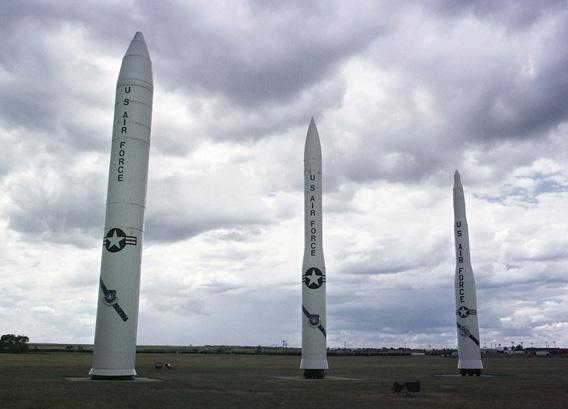
The treaty does not, however, specify the number of delivery vehicles of each type the two parties can deploy. How many must be on subs, how many in silos, how many in bombers. This makes the type of delivery vehicles a decision for the president or Pentagon, not a treaty matter. This is where my RE-START treaty (or executive order) comes in. I propose that the next smart, practicable step in the long-delayed, post-Cold War denuclearization of the super powers should be the abolition of all our silo-based missiles—the most dangerous, vulnerable, hackable, accident-prone of delivery vehicles. There are some 450 of them in our silos now, ready to fly.
I’ve been down in one of those silos. I later learned how one could evade the then-current, supposedly failsafe “simultaneous two-man, two-key launch requirement” in about 15 minutes from some missile crewmen who demonstrated how it could be done with a spoon and a string. That flaw has supposedly been fixed, but who knows what others lurk. (I describe this in my recent book How the End Begins: The Road to a Nuclear World War III). Cold War congressional investigations revealed far deeper, far more dangerous flaws in the “command and control” system (as it was then known), which contemporary students of the matter have argued persuasively have not been fixed. (Except that “command and control” has been given a sexy new Pentagon jargon tag: “C3I,” for “command, control, communication and intelligence.” Don’t you feel safer now?)
If some demonic hacker or simple signal glitch causes an inadvertent launch toward the Russian Federation, it might not help for us to IM the Kremlin saying, “Sorry, it’s all a mistake, your city being vaporized and all. We don’t want a war.” Analysts I’ve talked to (including a designer of the Russian system) agree that the Russian ICBM launch warning system known as “perimeter” is also on hair-trigger alert. Even if the Kremlin wanted to, it might not be able to prevent a major missile response to our accident. In other words, worst-case scenario, we’re all one mistake away from a global nuclear war.
Before disclosing the rationale for my proposed treaty, I’d like to ask a question that has always puzzled me. The president will need the support of activists across the board for any denuclearization he embarks upon. Why aren’t opponents of nuclear energy reactors in the forefront of anti-nuclear weapons activism?
Yes, there is some overlap among activists, but from my perspective as a student of the culture of nuclear weapons foes, I haven’t see anti-nuclear-energy activists put a lot of energy into abolishing planet-destroying nuclear weapons. In fact, hardly anyone except concerned scientists and former nuclear missile crewmen do. (See my Slate story about one of the first crewmen protesters.)
Why didn’t rage against unsafe nuclear reactors after the Fukushima accident spill over into rage against the presence on own soil of nuclear devices that could murder millions more with a single accident? Perhaps the mind-set is there, but maybe the problem is that most of the missiles and warheads are buried underground in silos or are undersea in subs, while nuclear reactor towers loom ominously and conspicuously over the landscape.
Each of those 1,550 warheads we’ll max out at in 2018 is in essence a flying nuclear power plant, only one that is designed to explode and kill. One Fukushima was terrible. Why is the prospect of 100 Hiroshimas—which could be the consequence of an accidental nuclear war between the super powers or a regional nuclear war among the seven other nuclear armed nations—considered a less urgent concern? There have been occasional protests, for instance against submarine-based Trident missile production facilities, but when the new START was struggling to get ratified, I didn’t notice any marches or rallies in support of it by the people who protest reactors. I think this is a serious issue that calls for some rethinking on the part of that movement’s leadership.
But to return to my treaty/executive order. To understand it, one must understand a long-entrenched but no longer essential concept of the Pentagon’s: the sacred strategic nuclear “triad.”
This was the Cold War “balance of terror” architecture, a fear-of-surprise-attack nuclear arsenal that called for three types of nuclear delivery vehicles. They were manned bombers; submarine missile-launching “platforms;” and the now-pointless, dangerous, hair-trigger alert, mistake-vulnerable silo-based missiles scattered in deep holes across the badlands of the western United States and the bleak steppes of Russia.
The goals of the triad (mirrored in the Soviet Union’s tri-partite nuclear dispositions) were to diminish the chance that a surprise attack could demolish all our methods of reprisal and thus defeat deterrence, the fear of retaliation which supposedly kept us safe from attack.
The silo-based Minuteman missiles were key to this because, as their name suggested, they had the capability of being launched in minutes, flying off to Moscow (or Washington) before they could be destroyed in their protective sheaths, which nobody believed protected them from multiple megaton strikes.
The need for speed dictated a “use it or lose it,” launch-on-warning philosophy when it came to signs of an attack. There were several horrifying close calls on both sides—including one in which our nuclear warning center mistook a flock of geese over Canada for incoming nuclear missiles. In another case, the Russians mistook the launch of a Norwegian weather satellite rocket for a NATO surprise attack. These episodes illustrate the peril of what in Pentagon jargon is called “inadvertence”—a mistaken missile launch that could touch off an unintentional nuclear exchange and kill hundreds of millions. In both cases we were lucky. Scariest of all was the incident in 1980 recounted in a memoir by former National Security Adviser Zbigniew Brzezinski. Training tapes of an all-out attack were mistaken for real, and Brzezinski was minutes away from calling the president. And on the other side of the world, a similar glitch was intercepted at the last minute by a Col. Stanislav Petrov before he called the Kremlin. We were lucky again. Will we always be?
The silo-based missiles have been “detargeted,” we’ve been told, but can easily be retargeted in seconds with a burst of code containing—say, Moscow’s GPS coordinates. They’ve been detargeted but not de-alerted (something I called for back 2008 in Slate). They’re still ready to go, at a moment’s notice, vulnerable to hackers despite the claims by some security experts they’re “air gapped from the internet”—but think USB sticks.
Nobody has yet explained the incident in late 2010 when 50 nuclear missiles in Wyoming stopped responding to the C3I system for a frightening period of time. The Pentagon hastened to say, hey, no problem, don’t worry that our computer system isn’t capable of error-proof command and control of 50 nuclear missiles for just a little while. The episode was not confidence-inducing, and it reminded us how much world-destroying power is entrusted to glitch-prone computer architecture. The fact that this sensational story was virtually ignored is further evidence of head-in-the sand consciousness we have about nuclear power.
When I discussed the matter of our “launch posture” with a Pentagon general who specialized in nuclear affairs, he refused to say whether these missiles could still be launched on the basis of “dual phenomenology.” This obfuscatory euphemism means that once we receive signals from two electronic tracking systems—radar and satellite—that something on the screens looks like an attack, we’d face the “use it or lose it” choice. We’d have to “launch on warning” before we knew that the warnings were not “false positives” like the flock of geese. Fortunately, it’s unlikely there could be two simultaneous false positives in our dual phenomenology, but a statistician’s analysis has argued that eventually it would happen. One prominent statistics expert, Martin Hellman, one of the inventors of the “trap door” and “public key” methods of encryption for the Internet, calculated a 1-in-10 chance of a nuclear exchange in the next decade, and Scientific American put it at a not-so-reassuring 1-in-30 for the same period.
Are we insane? Is the Pentagon so attached to its sacred triad that it will not let us pry these hair-trigger missiles away from them? The answer is yes. Because I write about this stuff, I just received an invitation to a congressional breakfast seminar on Capitol Hill in which “Sen. John Hoeven (R-N Dak) will respond to proposals calling for cuts to U.S. nuclear forces and call for a national discussion about the role nuclear weapons play in maintaining global stability in remarks entitled: ‘The Continuing Case for the Nuclear Triad.’”
I won’t indulge in a “lost my breakfast” joke but, sorry, there is no case for the nuclear triad anymore. It’s a further indication that no treaty process is going to bring about the triad’s reduction to a dyad. (And hopefully next a monad. After that a No-mad?) The nuclear arms reduction process may be stalled, but we must find a way to eliminate the dangerous, suppurating silo-missile leg of the triad and the danger of “inadvertence” those Minutemen in silos present now, before the next breakfast, the next flock of geese.
As I said, I see no constitutional or treaty obstacle to Obama and his new secretary of defense just deciding to change the type of delivery vehicles in which we place our precious 1,550 warheads. (In fact, it occurs to me that one reason he chose Chuck Hagel is that it might give him cover for doing so.)
I’ve always felt that Obama had his heart in the anti-nuclear struggle but that he had become disheartened by the military industrial complex’s clout. Sad that he didn’t mention the subject at all in his second inauguration speech. This isn’t an ideal or comprehensive solution, but it can restart movement in the right direction.
Obama can ask Putin to join him, and if Putin doesn’t go along with him he can do it unilaterally and challenge Putin to join him, implicitly challenging his manhood. (I can beat you with one leg of my triad tied behind my back.) And believe me, 1,550 warheads on bombers and subs is enough deterrence.
And if Putin dramatically decides to join in, that could earn him his Nobel. There’s something in my plan for everyone. But mainly: It can be done. Now. Get out the quick-drying cement or the hot liquid lead and get ready to entomb those Minutemen in their vertical coffins, stat.
Mr. Obama, have your people call my people, and we’ll go over the draft of the executive order I’m working up. Gun control is important, but a single nuclear warhead can kill not just 20 but 20 million people at a time. And time is running out.
