Black-and-white colobus monkeys scrambled through the branches of Congo’s Ituri Forest in 1957 as a small band of Mbuti hunters wound cautiously through the undergrowth, joined by anthropologist Colin Turnbull. The Mbuti are pygmies, about 4 feet tall, but they are powerful and tough. Any one of them could take down an elephant with only a short-handled spear. Recent genetic evidence suggests that pygmies have lived in this region for about 60,000 years. But this particular hunt reflected a timeless ethical conflict for our species, and one that has special relevance for contemporary American society.
The Mbuti employed long nets of twined liana bark to catch their prey, sometimes stretching the nets for 300 feet. Once the nets were hung, women and children began shouting, yelling, and beating the ground to frighten animals toward the trap. As Turnbull came to understand, Mbuti hunts were collective efforts in which each hunter’s success belonged to everybody else. But one man, a rugged individualist named Cephu, had other ideas. When no one was looking, Cephu slipped away to set up his own net in front of the others. “In this way he caught the first of the animals fleeing from the beaters,” explained Turnbull in his book The Forest People, “but he had not been able to retreat before he was discovered.” Word spread among camp members that Cephu had been trying to steal meat from the tribe, and a consensus quickly developed that he should answer for this crime.
At an impromptu trial, Cephu defended himself with arguments for individual initiative and personal responsibility. “He felt he deserved a better place in the line of nets,” Turnbull wrote. “After all, was he not an important man, a chief, in fact, of his own band?” But if that were the case, replied a respected member of the camp, Cephu should leave and never return. The Mbuti have no chiefs, they are a society of equals in which redistribution governs everyone’s livelihood. The rest of the camp sat in silent agreement.
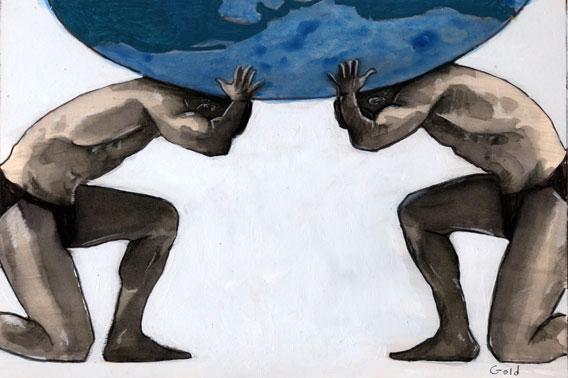
Faced with banishment, a punishment nearly equivalent to a death sentence, Cephu relented. “He apologized profusely,” Turnbull wrote, “and said that in any case he would hand over all the meat.” This ended the matter, and members of the group pulled chunks of meat from Cephu’s basket. He clutched his stomach and moaned, begging that he be left with something to eat. The others merely laughed and walked away with their pound of flesh. Like the mythical figure Atlas from Greek antiquity, condemned by vindictive gods to carry the world on his shoulders for all eternity, Cephu was bound to support the tribe whether he chose to or not.
Meanwhile, in the concrete jungle of New York City, another struggle between the individual and the group was unfolding. In October of 1957, Ayn Rand published her dystopian novel Atlas Shrugged, in which a libertarian hero named John Galt condemns his collectivist society because of its failure to support individual rights. “By the grace of reality and the nature of life, man—every man—is an end in himself,” Galt announced, “he exists for his own sake, and the achievement of his own happiness is his highest moral purpose.” Unlike Cephu, Galt had the means to end his societal bondage. By withdrawing his participation and convincing others to do the same, he would stop the motor of the world. Atlas would shrug. “Every living species has a way of survival demanded by its nature,” Galt insisted. “I swear by my life, and my love of it, that I will never live for the sake of another man, nor ask another man to live for mine.”
Ayn Rand’s defense of a human nature based on rationality and individual achievement, with capitalism as its natural extension, became the rallying cry for an emerging libertarian stripe in conservative American politics. Paul Ryan cites Atlas Shrugged as forming the basis of his value system and says it was one of the main reasons he chose to enter politics. Other notable admirers include Rush Limbaugh, Alan Greenspan, Clarence Thomas, as well as Congressional Tea Party Caucus members Steve King, Mick Mulvaney, and Allen West.
“Collectivism,” Rand wrote in Capitalism: The Unknown Ideal, “is the tribal premise of primordial savages who, unable to conceive of individual rights, believed that the tribe is a supreme, omnipotent ruler, that it owns the lives of its members and may sacrifice them whenever it pleases.” An objective understanding of “man’s nature and man’s relationship to existence” should inoculate society from the disease of altruistic morality and economic redistribution. Therefore, “one must begin by identifying man’s nature, i.e., those essential characteristics which distinguish him from all other living species.” She identifies two: a brain evolved for rational thought and a survival instinct based on the desire for personal freedom.
Ultimately, Rand was searching for the origin of John Galt in the pages of human nature. But was she right? Are we rational egotists trapped in a net of social obligations? Or are we an innately social species for whom altruism was integral to our success on this planet? There was only one place she could look: the Pleistocene.
The Pleistocene epoch, from 2.6 million to 11,700 years ago, was a formative time in our species’ development. The first members of the genus Homo began to walk the great savannas of Africa at the beginning of this epoch. In a little more than 2 million years, we went from loose aggregations of bonobo-like bipeds, traveling upright between patches of forest, to highly integrated societies made up of multiple families and clans. By studying the archaeological record as well as modern-day hunter-gatherers, evolutionary scientists have been constructing a record of how our early human ancestors made this journey. It is clear that John Galt was not present in our ancestral family tree.
Christopher Boehm has been studying the interplay between the desires of an individual and that of the larger group for more than 40 years. Currently the director of the Jane Goodall Research Center and professor of anthropology and biological sciences at the University of Southern California, he has conducted fieldwork with both human and nonhuman primates and has published more than 60 scholarly articles and books on the problem of altruism. In his newest book, Moral Origins: The Evolution of Virtue, Altruism, and Shame, Boehm synthesizes this research to address the question of why, out of all the social primates, are humans so altruistic?
“There are two ways of trying to create a good life,” Boehm states. “One is by punishing evil, and the other is by actively promoting virtue.” Boehm’s theory of social selection does both. The term altruism can be defined as extra-familial generosity (as opposed to nepotism among relatives). Boehm thinks the evolution of human altruism can be understood by studying the moral rules of hunter-gatherer societies. He and a research assistant have recently gone through thousands of pages of anthropological field reports on the 150 hunter-gatherer societies around the world that he calls “Late-Pleistocene Appropriate” (LPA), or those societies that continue to live as our ancestors once did. By coding the reports for categories of social behavior such as aid to nonrelatives, group shaming, or the execution of social deviants, Boehm is able to determine how common those behaviors are.
What he has found is in direct opposition to Ayn Rand’s selfish ideal. For example, in 100 percent of LPA societies—ranging from the Andaman Islanders of the Indian Ocean archipelago to the Inuit of Northern Alaska—generosity or altruism is always favored toward relatives and nonrelatives alike, with sharing and cooperation being the most cited moral values. Of course, this does not mean that everyone in these societies always follow these values. In 100 percent of LPA societies there was at least one incidence of theft or murder, 80 percent had a case in which someone refused to share, and in 30 percent of societies someone tried to cheat the group (as in the case of Cephu).
What makes these violations of moral rules so instructive is how societies choose to deal with them. Ultimately, it all comes down to gossip. More than tool-making, art, or even language, gossip is a human universal that is a defining feature of our species (though this could change if we ever learn to translate the complex communication system in whales or dolphins). Gossip is intimately connected with the moral rules of a given society, and individuals gain or lose prestige in their group depending on how well they follow these rules. This formation of group opinion is something to be feared, particularly in small rural communities where ostracism or expulsion could mean death. “Public opinion, facilitated by gossiping, always guides the band’s decision process,” Boehm writes, “and fear of gossip all by itself serves as a preemptive social deterrent because most people are so sensitive about their reputations.” A good reputation enhances the prestige of those individuals who engage in altruistic behavior, while marginalizing those with a bad reputation. Since prestige is intimately involved with how desirable a person is to the opposite sex, gossip serves as a positive selection pressure for enhancing traits associated with altruism. That is, being good can get you laid, and this will perpetuate your altruistic genes (or, at least, those genes that allow you to resist cheating other members of your group).
Sometimes gossip is not enough to reduce or eliminate antisocial behavior. In Boehm’s analysis of LPA societies, public opinion and spatial distancing were the most common responses to misbehavior (100 percent of the societies coded). But other tactics included permanent expulsion (40 percent), group shaming (60 percent), group-sponsored execution (70 percent), or nonlethal physical punishment (90 percent). In the case of expulsion or execution, the result over time would be that traits promoting antisocial behavior would be reduced in the populations. In other words, the effect of social selection would be that altruists would have higher overall fitness and out-reproduce free riders. The biological basis for morality in our species could therefore result from these positive and negative pressures carried out generation after generation among our Pleistocene ancestors. Who is John Galt? He refused to participate in society and no one has seen him since.
In fairness to the Russian-born Ayn Rand, the collectivist society she was most opposed to was the Soviet regime, which justified its consolidation of power with the veneer of altruism. Rand’s mistake was in essentializing the distinction between “individualist freedom” vs. “collectivist tyranny” and then transporting it into our human past.
However, deep in the Ituri Forest was a man Ayn Rand might have felt a bond with. Cephu had a reputation as someone who valued himself above all others long before he decided to maximize his personal profit margin on the community hunt. As Turnbull found when talking to the Mbuti tribesmen, Cephu never joined the rest of the group at breakfast whenever they strategized about where to set their nets. He would simply follow along once the decision had been made. To make matters worse, he was often loud and would frighten the animals away before they got close to the trap. Whenever he did get his share of the community meat, he would always take it to his own campsite rather than eat with everyone else (and could sometimes be heard yelling insults at the main camp once he was there). According to Turnbull, nearly everyone was irritated with Cephu’s self-serving behavior and gossiped about it. But most members of the community tolerated him in order to maintain unity. “Rather than cause an open breach,” Turnbull wrote, “everyone in the main camp kept his thoughts to himself and was silent.” But finally Cephu went one step too far.
“Cephu committed what is probably one of the most heinous crimes in Pygmy eyes, and one that rarely occurs. Yet the case was settled simply and effectively,” Turnbull concluded. Among the Mbuti, as with most hunter-gatherer societies, altruism and equality are systems that enhance individual freedom. Following these moral rules helps prevent any one individual from taking advantage of others or even dominating the group as a whole because of unequal privileges. However, just as it is in our society, the negotiation between the individual and the group is always a work in progress. Perhaps that is why, after the Mbuti had feasted on the day’s successful hunt, one member of the group slipped away to give the still moaning Cephu some of the cooked meat and mushroom sauce that everyone else had enjoyed. Later that night, Cephu turned up at the main camp, where he sat on the ground and sang songs with the rest of his tribe. Holding up the world isn’t so trying when there are others who can lend a helping hand.
