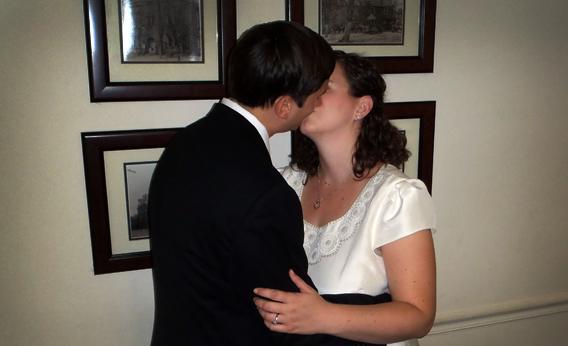
When I recently called my mother to tell her that I was getting married, she was ecstatic. After all, my boyfriend, Chris, and I had been together for nearly 10 years, so he had long been part of the family. “When’s the big day?” she asked me.
“In about 20 minutes!” I said, trying to sound perky instead of scared. Though we had decided to get married a few weeks prior, we told almost no one beforehand—not even our parents. And now, we were standing just outside the office of the man who would perform the ceremony.
“You’re getting married today?” she said, shocked. I braced myself for the worst—for her to say that I was robbing her of a precious time in a mother’s life. But she instead declared her unmitigated delight. And with that blessing on hand, I was wed. Chris, the officiant, and I were the only three people in the room.
Now a mere month into my marriage, perhaps it is dangerous to declare, “We did it the right way.” But as I look back at my humble little wedding, I feel pride—and the more I think about it, the more it seems that everyone should elope.
I love a good wedding just as I love any party with an open bar and “The Electric Slide.” But unless you are wealthy, come from a family that has never known strife, enjoy giving up an entire year of your life to planning, and can smile in the face of any possible wedding disaster (and mean it, not just for pictures), you should elope. That’s because weddings—even small-scale ones—are more pageant than sincerity.
True, I was never the fairy tale wedding type. As a child, I didn’t play bride unless peer-pressured. I can’t recall ever fantasizing about my wedding dress, let alone the flowers, the color scheme, or the cake. (Well, maybe the taste of the cake.) My father died when I was 11, and though I could foresee regretting many moments we would never share, walking down the aisle wasn’t among them. Because despite the popular idea that “every little girl dreams of her wedding”—an idea that keeps TLC churning out wedding reality shows—this is not so. I always dreamed of a lifelong partnership but never thought much of the froufrou affair.
The obvious reason to elope is the money. Over the summer, Brides magazine reported that, even in these tough economic times, the average couple spends nearly $27,000 on their nuptials. I have some doubts about that figure—the respondents were readers of Brides magazine and its website, a group already inclined to go veils-to-the-wall for a wedding. But there is no question that weddings, even those done on the cheap, cost far more than many couples can afford. While I have no qualms with the well-off (and their parents) shelling out for a classy affair, I did not want to go into debt or decimate my hard-earned savings for a party.
My primary objections to a “real” wedding go beyond the financial, however.
There’s the time it takes to plan a soiree for so many people. The travel to and fro to evaluate venues, the endless phone calls with vendors, crafting the perfect guest list—and, if you’re a modern bride, plain old crafting to capture that chic Etsy vibe. It’s not that my time is so valuable. My normal Saturday routine is Zumba followed by some mix of Bravo reruns, Netflix marathons, and reading. But I cherish, even need those hours of vegging after a full work week. Planning a wedding, in extreme cases, becomes akin to a job, one that costs money instead of bringing it in.
I also feared the possibility of falling down the tulle-lined rabbit hole. In 2007, when Slate ran a special issue on weddings, the normally sensible Meghan O’Rourke wrote that she was shocked to find herself saying of the invitations her fiancé chose, “But cream is too dark—and I really preferred the square!” When you are planning a wedding, it is easy to get caught up in the wedding sites, the cheerful pressure of vendors, and the excitement of friends. The woman on Say Yes to the Dress who breaks into hives because her gown has a scoop neck instead of a sweetheart certainly didn’t envision a rash when she first entered Kleinfeld’s. When you plan a wedding—and doesn’t everyone celebrate the bride who plans down to the last detail?—every decision takes on importance. As well it should—you’re spending a lot of money on those tacky favors everyone will throw out. So it’s not that I thought I was above the lure of wedding planning mayhem—it’s that I knew I wasn’t.
But perhaps the best reason to elope is that a wedding should be about the marriage. It wasn’t my day, but our day—mine and Chris’ alone.
Many men and women have told me that their weddings were so frantic—worrying about whether the caterer was late, whether a simmering family feud was about to boil over, whether everyone who should have been thanked was acknowledged—that it felt like a blur. We all know people who were too busy on their wedding day to eat the food that they so carefully selected—and if that isn’t a demonstration that a wedding is for everyone else but the couple, I don’t know what is.
Inevitably, something will go wrong at a wedding, and until science can erase bad memories, most people will always look back on the drunken fight or collapsed cake. And the more people in attendance, the better the chance that disaster—minor or major—will strike.
Instead, I remember an utterly calm, peaceful day. I worked in the morning, dialing in to a conference call from home. No one on the call knew I was about to get hitched. Then I put on the white dress purchased online (on sale!) and took a cab to get my makeup done—just because a girl’s eloping doesn’t mean she wants to look sloppy. Chris, who went into his office that day, and I met outside the Arlington, Va., circuit court clerk’s office to get our wedding license. (Virginia is like Nevada: You can get your wedding license the same day as your marriage—and no witnesses are required, either.) There, we stood in line behind a man who works for a hospice and was trying to arrange for a dying patient, unable to make it to the clerk’s office, to get married quickly—a story that reaffirmed my belief that marriage is about far more than a party.
License in hand, we walked across the street to a law office between a sandwich shop and a homeless outreach organization where a civil celebrant would marry us for $50 in cash. Does that sound unromantic? Maybe a little sad? It wasn’t. The five-minute ceremony, conducted by a warm, gregarious man who has reportedly married more than 40,000 couples, hit the important notes, with nary a tedious reading from a relative or pledging to a God I don’t believe in. Then we headed off to a rooftop bar to call our family and friends with the good news. Oh, and we were married.
Surprisingly, the reactions from our loved ones were almost uniformly positive—and though they might just have been attempting to make me feel better about something I already felt pretty good about (and that they knew they couldn’t change), most people in the aftermath have told us that we did it the right way.
A few months down the line, we’ll have a party for immediate family and our closest friends. Despite what one acquaintance said, we will not be throwing the party so we “can still get presents,” but because, without the pressure of a wedding as the backdrop, I truly do want to rejoice with those I love. And we’ll have fun, and some things will go wrong, because they always do. None of that, however, will color how I remember my actual wedding day—the day I only wanted to toast with him.
