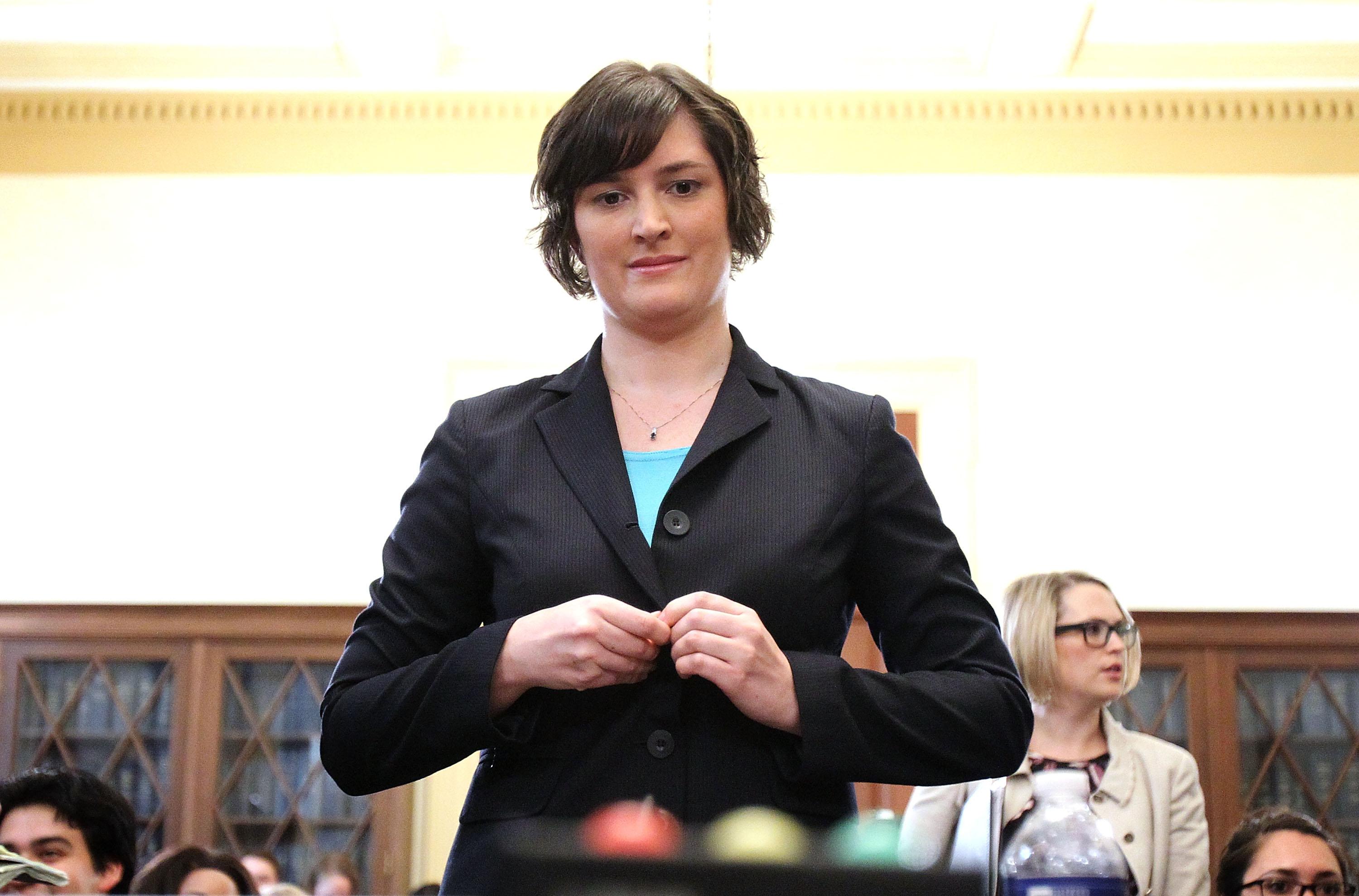
Sandra Fluke has pointed out that Rush Limbaugh tried to silence her when he called her a slut and a prostitute last week. But the oldest, hoariest trick for shutting women up didn’t work this time. Bolstered by her experience as an activist and a pitch-perfect call of support from President Obama, Fluke soldiered on in her efforts to persuade Georgetown University to include contraception in its package of health care coverage. She’s 30, not 14, and in her sober and smart TV appearances, Fluke is doing more than most of us ever will to take the sting out of slut shaming. Her forceful presence is the reason for Limbaugh’s apology over the weekend, utterly lame and inadequate as it was. How can he possibly claim that he didn’t mean to attack Fluke personally after hammering away at her for three days, even crazily suggesting that women who use birth control should post sex tapes online “so we can all watch.” May the advertisers who are running from Limbaugh, today joined by AOL, stay far far away.
Reclaiming the word slut is also the aim of the SlutWalks, the protest movement that started last spring in Canada and spread to more than 70 cities worldwide. Taking angry inspiration from a Toronto police officer who said the best way for women to prevent being raped is to “avoid dressing like sluts,” the women joining in SlutWalks have marched in all manner of bras, bodices, and other scanty dress. They won both enthusiastic applause and ambivalence from the feminist blogosphere. SlutWalks, and the broader reclamation projection they and Fluke stand for, represent a cultural shift that puts women’s sexual agency front and center rather than modestly cloaking it. Could that change also be the key to reforming rape law for the modern era?
That’s the thesis of Deborah Tuerkheimer, a law professor at DePaul University who is one of the first in the academy to digest the SlutWalk phenomenon. In a new article, Tuerkheimer argues that the “rise of sex-positivity,” as she calls it, is “the most significant feminist initiative in decades.” What’s distinctive about this reclamation is that women are insisting both on sex without rape, and on sexuality without judgment. And that insistence, Tuerkheimer points out, directly challenges traditional rape law.
In the protest movement of my own college days, Take Back the Night, women marched to make it safe to walk alone in the dark. The primary concern was stranger rape and physical safety. The SlutWalks conception is about acquaintance rape or date rape—the category of sexual assault that accounts for 90 percent of the whole. When women (or men) accuse people they know of rape, it’s far trickier for police and prosecutors to address, because the legality of the encounter turns on consent rather than force. Traditionally, rape law focuses on the latter. It sounds retrograde, I know, but as Tuerkheimer reminds us, in a majority of states, “a woman’s non-consent alone is thus insufficient to establish rape.” This makes it very hard to win convictions in the he said/she said realm of date rape. And it also means that a judge or jury can deem a woman who is totally passive—because she is asleep or drugged, for example—to not have been raped, even if she said she was.
Rape law also still treats certain kinds of sexual conduct as unacceptable for women, by exempting it from the rule that places a woman’s sexual history outside the bounds of evidence that can be admitted at a rape trial. Rape shield laws prevent defendants accused of sexual assault from putting a woman’s entire past on trial to discredit her. But courts still allow in this evidence if the judge thinks it shows a pattern of behavior that’s in some way distinctive. In many cases, it’s deviance that’s deemed to make a woman’s history distinctive, allowing the court to give the jury the chance to conclude that a particular’s woman’s claim of rape is less legitimate. “Women whose pasts involve consensual sex of a disapproved kind are presumed to be unrapeable,” Tuerkheimer writes. “Most vexing are acts of prostitution, group sex, and sadomasochism.”
The women of SlutWalks, of course, reject all of this. They think women, not old-fashioned judgments rendered by the state, should define what sex they want and what sex they outlaw. In this feminist roar Tuerkheimer sees a way to shift the rape paradigm once and for all. She wants judges to stop treating certain women as not rapeable based on the kind of sex they’ve consented to in the past. And she wants a new crime of acquaintance rape that topples the rule that it’s only rape, legally speaking, if there’s force involved. On this front, there’s progress in the new definition for collecting local rape statistics announced by the Department of Justice in January. DoJ now defines rape as “penetration, no matter how slight, of the vagina or anus,” that occurs “without the consent of the victim.”
Tuerkheimer sees the wider feminist rebellion against slut shaming as crucial to forcing more changes along these lines from courts and legislators. Feminist consciousness, she says, could “enable a legal shift that would not otherwise be possible.” I’m not in the habit of imagining that feminists have such power, but in this season of uproar over Limbaugh, why not? Tuerkheimer urges the SlutWalkers to start talking to the law professors and lawyers, and vice versa. It takes a law professor to say that, of course, but maybe Tuerkheimer has pointed out a virtue of the muscular feminism that proudly rejects slut shaming that feminists themselves have so far missed.
Sandra Fluke plays a role here, too. By making the case that women need insurance coverage that includes birth control—to protect their health in some cases, and in others, yes, simply to have sex—she is reminding us that of course this is part of who we are. We don’t have to modestly avert our eyes from that reality or keep quiet about it, either. That’s what President Obama understood when he told Fluke her parents should be proud of her. Feminists have plenty to be proud of Fluke for, too. For standing up to Limbaugh, for sure, but also for helping to make the revolt against slut shaming as mainstream as she is.
