Dove recently unveiled its latest campaign, and it hinges on the idea that your armpits are ugly. Dove Ultimate Go Sleeveless is supposed to give women “softer, smoother underarms in just five days”—in ads for the product, which Stephen Colbert calls a “breakthrough shame-o-vation,” women cut the sleeves off their tops with joyful expressions, as if they’ve been liberated from a terrible scourge. If it’s news to you that this part of your body is not so hot, Dove says you’re in the minority, citing a survey in which 93 percent of women said they “think their underarms are unattractive.” And if you doubt statistics culled from 534 women in an anonymous online poll, rest assured that Dove’s best advertising efforts will be directed at making those numbers true.
Pity the poor deodorant-makers. What else are they to do? As the Wall Street Journal points out, they’re in a bind—almost the entire U.S. population already uses deodorant, and consumers appear reluctant to switch to new brands. Dove’s empowerment-via-shame marketing approach for Go Sleeveless has its roots in advertising techniques that gained popularity in the 1920s: a) pinpoint a problem, perhaps one consumers didn’t even know they had; b) exacerbate anxiety around the problem; c) sell the cure.
The history of ads directed at women is particularly rich with such fear tactics. Thus, ad copy from the 1920s and ‘30s warned women of their place in the “beauty contest of life” (a corset manufacturer) and reminded them that “The Eyes of Men …The Eyes of Women/ Judge your Loveliness every day” (Camay soap). A 1953 ad for Chlorodent toothpaste stated point-blank: “There’s another woman waiting for every man.” Yikes!
“In advertising terms,” writes historian James B. Twitchell in Twenty Ads That Shook the World, “you don’t sell the product, you sell the need.”
Herewith, a brief history of our ugliest body parts, as recounted by the advertising industry:
Bad Breath
The substance that became Listerine was first invented in the late 19th century for use as a surgical antiseptic. In the 1920s, looking to goose sales, Gerard Lambert, son of the company’s founder, began casting about for other uses for the product. As Stephen Fox writes in The Mirror Makers: A History of American Advertising and Its Creators, Lambert consulted a chemist and discovered that the product could be used for bad breath. Ad copy adopted the term halitosis “as a sober, medical-sounding way of referring to the unmentionable,” Fox writes. Using a technique Fox calls “advertising by fear,” the copy for Listerine suggested that consumers could have bad breath without knowing it, since even their closest friends might not tell them.
Listerine targeted men and women, but the phrase “often a bridesmaid but never a bride” was made famous by the company’s ads. In one 1925 image, a woman reads another woman’s wedding announcement with a troubled expression on her face. “Her case was really a pathetic one,” the copy intones, describing the woman as nowhere near marriage “as her birthdays crept gradually toward that tragic thirty mark.” The culprit? Halitosis, of course.
“It’s hard to assess Lambert’s genius fairly,” writes Twitchell in Twenty Ads. “It looks so easy, but it was a combination of staking a claim on a body part, knowing how to use constructive discontent (shame) as a selling tool, of realizing the power of research, and then of hammering it home.”
Of course, it’s not that people’s breath didn’t smell before, Twitchell points out—rather, “it was not considered socially offensive.” Listerine changed that, creating both the problem and its cure.
Smelly Underarms
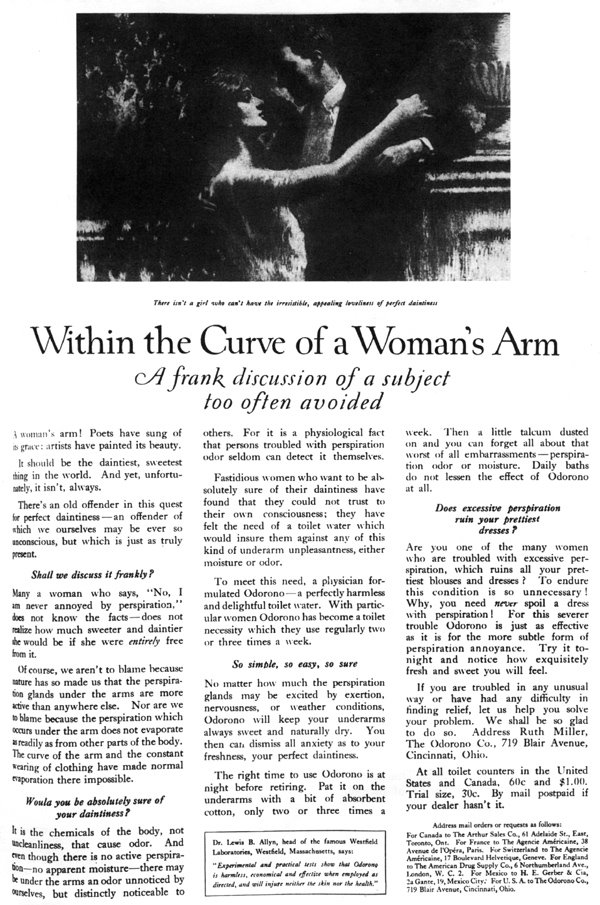
Odorono wasn’t the first commercial deodorant in the U.S., but it played a role in the delicate art of marketing the “unmentionable.” As historian Juliann Sivulka has written in a paper on deodorant advertising, this particular brand of “toilet water for perspiration” first began to take off in the 1910s. The company had some success with more traditional types of advertising—small print ads emphasizing the safety and efficacy of the product, which was then primarily marketed to women. But its sales plateaued, and when the company’s ad agency conducted home surveys it discovered that many nonusers considered Odorono a product for other women, those with serious perspiration problems, not for themselves.
This is when the advertisers tried something new. Combining the promise of romance with the horror of rejection, a full-page ad in a 1919 issue of Ladies’ Home Journal offered the image of a man and woman about to embrace. The copy explained that “fastidious women who want to be absolutely sure of their daintiness have found that they could not trust to their own consciousness,” because “it is a physiological fact that persons troubled with perspiration odor seldom can detect it themselves.”
Could the reader be absolutely sure she didn’t smell, even just once in a while—maybe at precisely the wrong moment, in a moonlight garden in the arms of her lover? Or, as the ad put it, “Would you be absolutely sure of your daintiness?” With a few precise jabs at the readers’ insecurities, the ad transformed Odorono “from a proprietary medicine to a beauty aid,” Sivulka writes, shifting “an unmentionable topic to one of primary importance to every woman.”
The Many Troubles of “Down There”
Down there is its own continent, and over the decades a myriad of marketing strategies have arisen to conquer it. The book Flowhas chronicled the challenges of selling menstruation products without offending the delicate sensibilities of the American consumers. (DoubleX ran a slide show from Flow co-author Susan Kim back in 2009. Please note that the slide show might render improperly in some browsers.) But pads and tampons are not the only corner of the feminine hygiene market that has been cloaked in euphemism. Consider douches and feminine deodorants, which offered the promise of what ads have labeled “intimate daintiness.”
From the 1930s through the 1960s, according to Andrea Tone’s Devices and Desires, the top feminine hygiene product in the country was Lysol. In addition to being marketed as a mouth gargle, a household cleaner, and more, the disinfectant was sold as a douche. Consumers understood that Lysol douche was to be used as a contraceptive, Tone writes, although the ads used veiled language, alluding to problems like “germs” and “odors,” and suggesting that a wife’s “fear of a major crisis” (code for becoming pregnant) could lead to marital discord and divorce. The ads tended to lay the happiness of the marriage—and the power to limit family size—squarely in the woman’s lap. Only the “proved germicidal efficiency of Lysol” can “restore every woman’s confidence in her power to please,” one 1948 ad declared.
The unfortunate truth was that as a contraceptive, Lysol was ineffective, not to mention dangerous. Improperly diluted, it burned and blistered the vagina, and in some cases even caused death. Yet, Tone writes, it wasn’t until the pill came along that Lysol douche was supplanted as the top choice of women looking to prevent pregnancy.
In the ‘60s, ads for feminine deodorant sprays and feminine wipes continued with the theme of troublesome odor, but without the double meaning. In her brilliant 1973 Esquire piece on feminine hygiene sprays, Nora Ephron traced how marketers surfed the wave of the sexual revolution to sell a product that, if anything, ran counter to the idea of liberated sexuality. Like Lysol douche, products such as FDS, Massengill Powder, and Bidette Mist at once aroused anxiety about women’s vaginas and offered solutions to the problem.
Ephron quotes a 1968 ad for FDS posing the question of whether women need more than underarm deodorant. “Yes,” the ad helpfully answers itself. “A woman, if she’s completely honest about it, realizes her most serious problem isn’t under her arms.”
Well, the makers of Dove Ultimate Go Sleeveless might beg to differ.
Click here to view a slide show on the history of body-shaming ads.