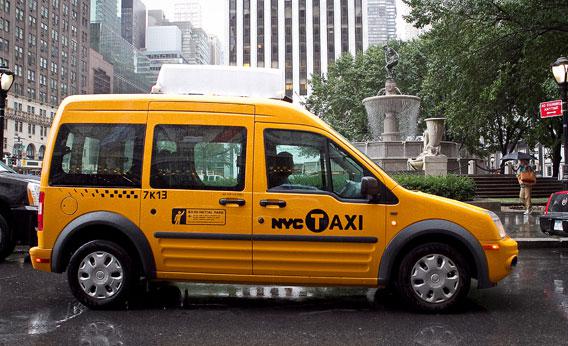
When New York’s Taxi and Limousine Commission held a public hearing last week to consider whether to raise taxi fares by 20 percent, cabdrivers pled poverty and passengers argued that fares are too high. Paradoxically, both groups were right.
This lose-lose scenario is only possible under the taxi medallion system, a regulatory scheme in which the right to operate a taxi is thoroughly divorced from the actual work of driving one. It’s a classic example of the perils of financialization, the process through which economic potential is turned into a liquid and leveraged asset. By converting a portion of cabbies’ future revenue into a freely tradable asset, New York, Chicago, San Francisco, and a host of other cities have created a powerful investor class, medallion owners and financiers, whose interests routinely compete with those of drivers and passengers.
“Compete” may be the wrong word, however, since owners of the aluminum placards don’t have much experience with losing. Over the last decade, their victories have driven the price of a medallion from around $200,000 to more than $1 million in New York. Medallion owners from Boston to San Francisco have been similarly fortunate, with medallions in Chicago appreciating even faster than the sustained 16 percent per year gains seen in New York.
New York fares have gone up six times over the last 30 years, yet drivers’ real income has fallen because of rising gas prices and surging medallion leasing costs. Bhairavi Desai, the head of New York’s nonprofit Taxi Workers Alliance, isn’t far from the mark when she calls the current system “feudal.”
The public hasn’t fared much better. Deep-pocketed medallion owners have hijacked public policy through lobbying and legal challenges. Just last week medallion owners won a legal victory blocking Mayor Bloomberg’s plan to create a fleet of “green cabs” to serve New York’s outer boroughs, and last year medallion owners successfully stymied New York’s attempt to shift to hybrid taxis.
Studies have even drawn a link between the medallion system and crummy cab service, which might seem far-fetched until you consider that drivers begin each 12-hour shift owing as much as $130 to their leasing company. If you were spending half your shift just trying to break even, you’d employ bat-out-of-hell driving tactics and tell rush-hour Manhattan fares that you didn’t know where Queens was, too.
Things weren’t always this way. When New York City first issued taxi medallions in 1937, they were just licenses, worth $150 in today’s terms. In the years after, life was pretty good for cabbies, as it was for many low-skill employees in postwar America. Some drivers owned their cabs. The rest were unionized employees who worked on commission and received a full slate of employee benefits.
Crucially, the owners were in the taxi business and took on the risk that entailed. If gas prices went up, that came out of the owners’ pockets. If drivers had a bad shift, the owners did too.
All that began to change in 1979. That year, New York’s Taxi and Limousine Commission changed its rules to allow medallions to be leased out for 12-hour shifts, making cabdrivers “independent contractors” under federal labor laws. The move cost such drivers their benefits, but the real fallout was far more profound. Even for medallion owners who operated their own taxi fleets, the economic value of the right to pick up fares was now severed from the value of actually doing so.
It turns out that the former business is a hell of a lot better than the latter.
Under a medallion lease, the medallion owner has a constant stream of income. Drivers are the ones who suffer when gas prices rise or a cab gets stuck in traffic—they’ve still got to make their daily lease payments. More importantly, New York’s tight limits on the number of medallions in circulation has suppressed the supply of cabs. There are 13,237 medallions now outstanding, a few hundred fewer than in 1937, but a huge supply of drivers competing to lease them.
In practice, a fixed number of medallions is just a fact of the system. In New York, Chicago, and Boston, the number of medallions has barely budged since they were issued in the 1930s. New York went 60 years without issuing new medallions, and it’s only been a trickle since.
Restricted supply makes for high medallion prices, and that in turn leads to consolidation in the industry. Only around 18 percent of cabs are owner-operated, putting most medallions in the hands of big taxi fleets or brokers who simply rent them out. The limited number of shifts and oversupply of drivers looking to work means that the fleets only rent out cabs by the shift, the shortest term, most profitable way possible.
For proof that owning a medallion is an economic turkey shoot, just listen to Andrew Murstein. He’s the chief executive officer of Medallion Financial, a publicly traded company that owns hundreds of medallions and lends money for medallion purchases.
“Taxis are little cash cows,” he announced in an interview last summer touting medallion ownership. Even passive investors who farm out their medallions end up with a 5 percent return, he said.
Because Murstein’s company owns a bank, it’s able to take advantage of the Fed’s low interest rates to borrow money for 0.35 percent and loan it out to striving young cabbies who want to own a medallion. The cabbie borrows at around 5.5 percent, with 25 percent down.
“If a borrower doesn’t pay, we send out somebody,” Murstein said. “Literally, they can pop the medallion off the hood of the car and bring it back to our office and, bingo, the guy is out of work.”
While owners and financiers thrive, drivers are having a harder and harder time. Though figures for driver earnings are hard to come by and vary widely, shortly after the most recent fare raise in 2006, a report [Page 36] from an independent consulting company found that drivers’ take-home pay for a 12-hour shift averaged $158. (Last year the NYTWA calculated it at $96.) By all accounts, it’s slipped since.
The principal reason for drivers’ diminished fortunes is that every time taxi drivers ask for a fare raise to cover increased operating costs, the medallion owners’ trade association tries to come along for the ride. Known as the Metropolitan Taxi Board of Trade, the organization has been remarkably successful at convincing the Taxi and Limousine Commission to give them a cut of any fare hikes.
In 2004, the last time the TLC increased fares across the board, drivers got a 26 percent fare increase and MTBT secured an 8 percent [Page 36] increase in the lease rate. In 1996, the commission signed off on a 20 percent fare increase and a 14 percent [Section3.8] boost for lease rates. This time around, taxi drivers have asked for a 20 percent hike in fares. How much would the MTBT like to increase lease rates? Why, it thinks 20 percent is only fair.
There’s no good public policy reason why medallion owners should get any of the extra fare money, of course. But the power politics of the taxi business ensures that owners’ dominance over drivers will continue, without any benefit to passengers.
The TLC has a long history of being in the bag for the medallion owners, but lately it’s pushed for reform. Under its current chairman, David Yassky, it has challenged the owners by backing expansions to the city’s taxi fleet, like the pending plan to let “green cabs” pick up fares.
Unfortunately, there’s not much to show for those good intentions. While medallion owners have dexterously used the courts to block policies contrary to their interest, no one is seriously proposing to overhaul the system that gives them so much power. Even Yassky has reassured investors that change is not on the way. “Nobody would do anything that disrupts the function of the taxi marketplace,” he announced in a Bloomberg TV interview.
Such inertia is an inherent trait of the medallion system, it appears. In 2009, Washington D.C., considered legislation to implement a medallion system and asked its finance office to study how it worked in other jurisdictions. Three months later, the finance office issued a report that helped killed the medallion proposal. In every city D.C. looked at with medallions, the quality of service went down and owners earned windfall profits at the expense of drivers and passengers.
Yet despite the system’s obvious failure, D.C. found that no cities were seeking to change it.
“A taxi medallion system is nearly impossible to end even if it proves to be providing unfairly high gains to a limited number of original medallion owners,” the report concluded. “Medallion owners fiercely resist any possible threat that may challenge their advantage.”
There is a structural explanation for this, too, and it’s especially bad news for New York. While the costs of medallion ownership are spread over an entire city, the benefits accrue to a single-issue constituency that fights in proportion to how much their medallions are worth.
In New York, the owners have put in an effort worthy of a seven-figure asset, from fundraising for New York Gov. Andrew Cuomo to courting borough politicians. Medallion owners may not contribute to a better taxi industry, but when it comes to politics, they work harder than the rest of us do.
