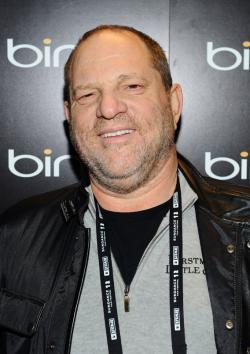
Until a few weeks ago, Harvey Weinstein had no idea who designed his tuxedos. “A fashion blogger asked me at the Directors Guild awards,” he told me over breakfast recently. “I had to look at the label. My wife [Georgina Chapman, designer and co-founder of the Marchesa fashion label] buys them for me … They’re all laid out in the closet like when I was in school.”
Weinstein clearly has more important things to think about than who makes his suits. The burly 59-year-old is, after all, the man who turned independent cinema into a thriving global business, launched the career of Quentin Tarantino, and last month was addressed as both “God” and “the Punisher” by Meryl Streep as she accepted a Golden Globe award.
And yet a tuxedo, worn most weekends from January to March as he attends a succession of the awards ceremonies that can help turn a film into a commercial hit, is practically a uniform for Weinstein. So far this year, he has dressed up for the Baftas, Screen Actors Guild awards, Globes and all the other events that can seem like mere warm-ups for the main event: the Oscars.
On Sunday, at the 84th Academy Awards, a tuxedo-clad Weinstein will once again walk the red carpet into the glitzy auditorium and find himself front and centre at Hollywood’s biggest night.
With 16 nominations for three films – The Artist (favourite to win best picture), The Iron Lady, and My Week with Marilyn – released by his company, Weinstein has finally returned to the pre-eminence he and his brother, Bob, once enjoyed with Miramax, the film distribution company they founded in 1979. Named after their parents, Miriam and Max, and later acquired by Walt Disney, Miramax revolutionised the industry, delivering a string of critical and commercial hits, such as Sex, Lies and Videotape (1989), Pulp Fiction (1994), The English Patient (1996), Good Will Hunting (1997), Shakespeare in Love (1998) and Chicago (2002).
But when the brothers left Disney in 2005 to set up the Weinstein Company, with $1bn raised by Goldman Sachs, their dreams of an expanding media empire began to sour. While still with Miramax, Weinstein had experimented with publishing, co-funding with Hearst the short-lived magazine Talk. In 2006 he bought A Small World, an online social network for the wealthy and connected, and, a year later, the fashion label Halston. Taking directorships with other companies, he neglected his biggest talent: finding and distributing movies. In its first three years, the Weinstein Company couldn’t buy a hit, money was running out and Hollywood was abuzz with talk that Weinstein was finished.
All of which will seem like ancient history on Sunday evening when the mogul takes his seat and the curtain goes up on the Oscars. Weinstein’s Oscar comeback, which began last year with The King’s Speech, has snowballed into 2012, with more nominations than he has had in years.
“I don’t think I ever fell out of love with movies,” growls Weinstein, when I ask why he seemed to lose his touch after leaving Disney. “But I fell out of love with the politics of making movies. It had reached the point where I didn’t want to do it any more, not in the same way, anyway.”
It is Sunday morning and we are in a Beverly Hills hotel with David Glasser, the Weinstein Company’s chief operating officer, and Weinstein has just ordered a protein shake. They explain that a company restructuring – and a change in focus for Weinstein – helped get things back on track. “The key was seeing Harvey at the film festivals,” says Glasser. In the Miramax days, Weinstein would religiously attend festivals, seeking movies to release. But when he became preoccupied with building a media empire, he neglected the events. “Between 2005 and 2008, he would maybe show up for a day and that would be it,” says Glasser. “Now, he’s showing up again.”
Not all of Weinstein’s new business ventures turned out badly. Project Runway, a reality show about fashion designers developed while at Miramax, is a global hit, becoming a foundation of the company’s growing TV division. But the others were a costly distraction: at one point the company was saddled with $480m of debt. Drastic action was required: Goldman Sachs, the company’s main lender, was given a library of 200 Weinstein movies as collateral. Goldman will keep the library, which produces income every year, until the debt, since cut to about $200m, is paid off. Halston and A Small World were sold while the company’s 200 staff was cut to about 80. Weinstein, the mogul who never backed down, earning as many enemies as friends in Hollywood for an abrasive, take-no-prisoners style, had, improbably as it seemed, conceded defeat. “The ideas [for the other businesses] were sound but they were poorly executed,” he says with a sigh. “I give myself full credit for the poor execution.”
Without the other businesses to worry about, Weinstein turned his attention back to movies, releasing a string of films that show he has not lost his touch. The humility is new, though: the Weinstein of 2012 is not the same as the swashbuckling figure that spent much of the past 30 years upending established hierarchies in Hollywood. The change has been noticed by long-time friends, such as Greg Coote, the film producer who sold him My Left Foot (1989), one of Miramax’s early hits and the movie that won Daniel Day-Lewis his first Oscar. “We have a different Harvey at the moment,” says Coote. “He’s a milder, gentler person now. Maybe that’s just age but I think he was humbled by the experience of going through the problems he had and coming out the other side.”
Weinstein also has a reputation for having a fiery temper. In Down and Dirty Pictures: Miramax, Sundance and the Rise of Independent Film (2004), the writer Peter Biskind refers to an incident when Weinstein allegedly manhandled a New York Observer reporter out of a party (Weinstein denies the incident took place). “He is who he is,” says a friend of Weinstein’s. “He has incredible drive, which is sometimes fuelled by intense anger and emotional swings, which sometimes manifest themselves as physical swings at people.
“But a lot of his passion comes from wanting to do things the right way. He is so passionate about film and a lot of other people in the industry are not, which is why he loses his patience sometimes.”
Weinstein tells me he toned down the aggression when the brothers left Disney to form the Weinstein Company. “We wanted to be extremely well-liked as we built these other companies, and non-confrontational.” That sounds like a departure from his previous incarnation at Miramax, I say. “Absolutely. I think what we found is that there’s a way to be confrontational and still be well-liked, as opposed to the previous incarnation, which was just confrontational. We didn’t care if we were well-liked as long as the movies were good. We served the movie – that was our master at Miramax. In our second incarnation, the movie is still the master but we’re getting the same results in more subtle ways.” He chuckles. “We don’t back down either, by the way.” This is perhaps what Meryl Streep was intimating at the Golden Globes when she and Madonna both referred to Weinstein as “the Punisher”.
I call Streep to ask what she meant. “He can’t get his heart out of the way of his head, which is a strength as far as I can see,” she says. “He can be really hard on people … But it’s always, always, in the service of what he sees is the best interests of the film, commercially or artistically.”
When it comes to the Oscars, Weinstein has good reason to hold his ground and fight to make sure his films get recognition. Oscar success can “transform a movie economically,” he says. “[When] I won a best picture nomination with Chicago, we were at $75m gross, and we ended up grossing $175m [in the US] and $350m worldwide, with the best picture win.”
The King’s Speech, which won for best picture, actor, and screenplay last year, was produced for a budget of less than £15m. “We thought the film would gross $10m-$15m in the US,” says Iain Canning of See-Saw Films, which produced the movie distributed in the US by Weinstein. Thanks to the successful Oscar campaign, the film grossed more than $400m worldwide.
Weinstein has an astonishing record at the Oscars. In 1998, he pulled off one of the greatest best picture shocks, masterminding a campaign that saw Shakespeare in Love defeat the highly fancied Saving Private Ryan. An awards campaign has a dual purpose for Weinstein. The weeks of other awards shows in the run-up to the Oscars provide bountiful publicity for a movie that might otherwise struggle. A careful hand is needed, he says: releasing a movie such as The Artist “wide” on 2,500 screens across the US would have been foolish in the early weeks of its release. Instead, he has allowed awards momentum to build, fuelled by its success at the Golden Globes and Baftas, and purposely not added too many screens.
“We were very slow on the pedal with The Artist and I won’t let anyone drive the car,” he says. “I get a call and someone says, ‘It just got 11 Bafta nominations!’ And I say, ‘Don’t add any theatres. Just keep it where it is. We’re going to make the move … It’s coming but not yet.’ ”
He is the master at persuading audiences to watch challenging films – and what could be a harder sell to the multiplex generation than a silent, black and white movie? “There’s not one thing this movie has going for it, except for the fact that it’s great,” he says. It could run out of steam “if it was overly distributed. Look, we’ve got 10 Academy Award nominations, we’re in 800, 900 theatres. Most people would go straight to 2,500. We will go to 2,500 … but not now.”
This staggered approach extends to how the films are advertised. Streep says: “When I first came to the office after The Iron Lady was finished, they showed me a poster for the film. I went insane because it was so good. But Harvey said, ‘No, we’re going to hold off.’ ” He wanted to use it at a later stage of the film’s release for the biggest possible impact.
Weinstein calls this having to “baby” a film – nurturing it, adding screens slowly, tweaking the marketing and allowing buzz to build. He recalls City of God, the 2002 Brazilian film about life in the favelas of Rio. It was a critical rave but initially struggled to find an audience. “People would say, ‘It’s the best movie I’ve ever seen!’ I would say, ‘Really? So why is nobody seeing it?’
“Then I realise, OK, I can have the best looking ads but you know what’s going to work? Tenacity and word of mouth.” So Weinstein kept City of God in some cinemas for 72 weeks, an astonishing time in an age when some films barely last a month. “You know what? It got nominated for four Academy awards, won three and everyone’s seen it now.” He was about to release the film on DVD when he got a call from Russell Crowe. Weinstein puts on an Australian accent. “He said, ‘Mate, that’s the best movie I’ve ever seen.’ Russell makes that call and that was another 12 weeks in theatres.”
Of course, Weinstein does not need to “baby” every film to make it a commercial success. The company’s slate for 2013 is packed with movies that could support a wide release as they feature the kind of A-list stars that will attract a big audience: Brad Pitt as a mob enforcer in Cogan’s Trade, and the return of Quentin Tarantino with Django Unchained, starring Leonardo DiCaprio. “It’s Quentin’s greatest script,” enthuses Weinstein. “It’s not even close to his other movies.”
DiCaprio plays a villain in the film and I ask why the star seems to miss out on awards recognition, most recently with J. Edgar , which failed to earn him an acting nomination despite fantastic reviews. “He’s definitely getting nominated for this one,” says the master Oscar campaigner, back where he belongs in the heart of the action. “Trust me. Leave DiCaprio to me.”
This article originally appeared in Financial Times. Click here to read more coverage from the Weekend FT.
