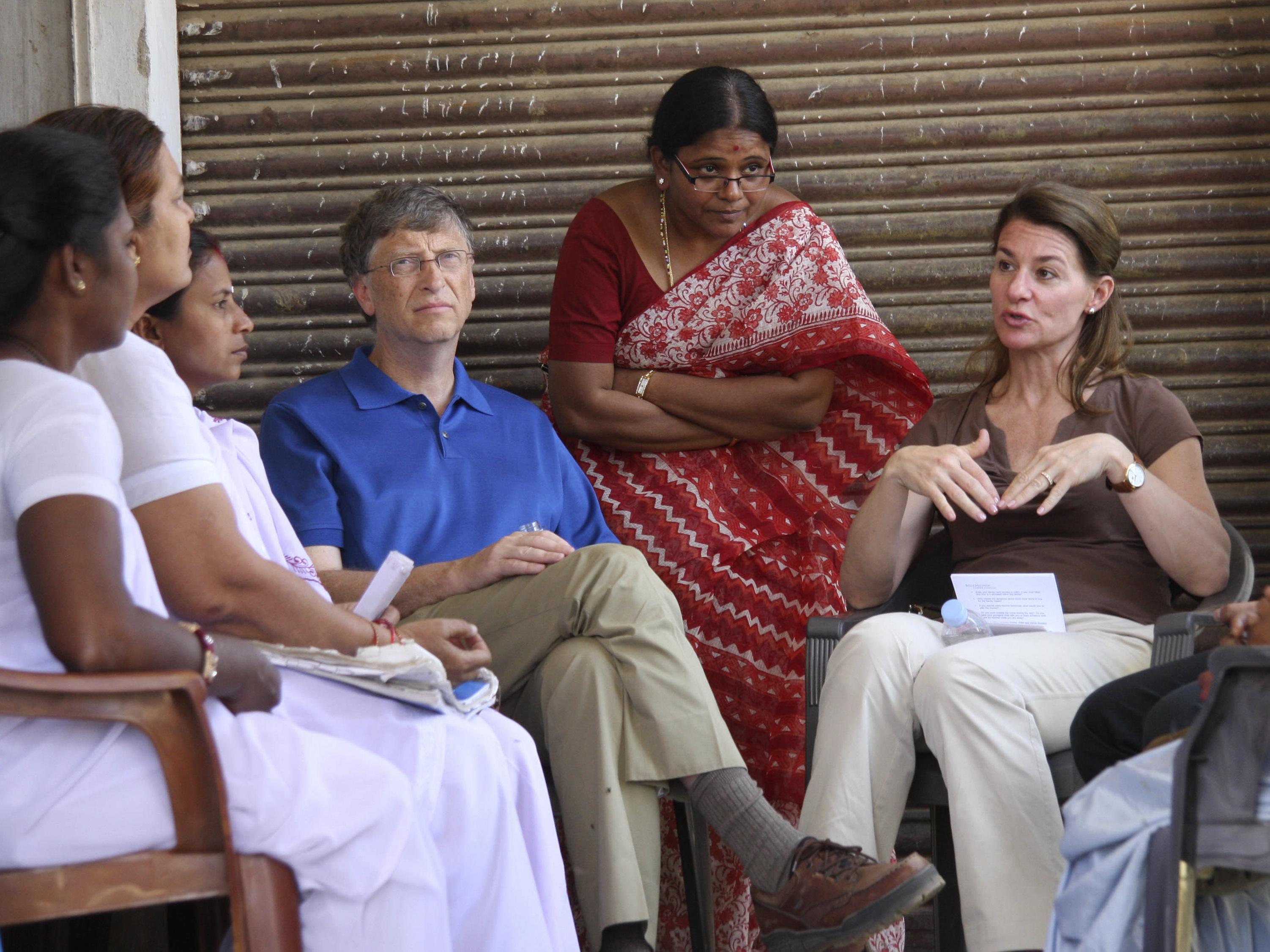
Melinda Gates sits, calm and engaged, making direct eye contact – not the piercing variety favored by most executives in the technology world she hails from, but an interested, almost intimate, kind. In her sixth-floor office at the Bill & Melinda Gates Foundation, Gates describes a work life fighting poverty in the developing world, balanced with a home life as a down-to-earth billionaire in Seattle. She wears a distinctive mustard-yellow jacket and a faint dusting of gold eye shadow to match, only because she spoke in front of 100 academics earlier in the morning. Normally, she wears no make-up.
Gates is arguably the wealthiest woman in the world. With an estimated net worth of $53bn, her husband Bill Gates, former chief executive of Microsoft, ranked number two on the Forbes list of the world’s richest people this year, behind Carlos Slim of Mexico. They certainly live comfortably in a $125m house in Seattle. But Gates is not one for gallivanting around at society dinners in fancy dresses and flashy jewelry.
After spending as many weeks as she does sitting on dirt floors in dilapidated huts, talking to mothers in Malawi, Ethiopia and northern India, one of whom recently asked Gates to take two of her children back to Seattle with her, Gates is grateful to have clean water come out of her shower. “You come home from some of these countries and you see how completely different it is,” she says. “Just to have a car that you drive down the street and you turn your seat heater on … it seems superfluous. Very superfluous.”
Gates talks about her wealth almost as though it is a cross she must bear. Indeed, she and her husband have made the bold decision to give away 90 per cent of their money and, with Warren Buffett, have called on other billionaires to donate 50 per cent of their fortunes to charitable causes. But Gates would never be satisfied with just writing a huge check to help the poor, then enjoying a lavish lifestyle. “I’m giving my life to this,” she says.
Since she and her husband went on safari in Africa in the early 1990s to celebrate their engagement, Gates has paid close attention to the inequities around the world between the classes and the sexes. “We would be driving down the street in a place like Zaire, now the Democratic Republic of Congo, and started to see, my gosh, the only people that have shoes are men,” she recalls. “Why does that woman have a baby in her belly and one on her back, and she’s carrying a huge load of bananas? You start to ask these questions.”
Gates was raised in a middle-class Catholic family in Texas. She studied computer science at Duke University, and went on to get her MBA there. She then joined Microsoft, where she worked for nine years on various products, from Publisher to Expedia, and met Bill Gates, almost two decades into his tenure as the chief executive. After they married, she left the company to start a family. They have three children – two daughters and a son in the middle – aged 15, 12 and nine.
They set up the foundation the same year they married, in 1994, with Melinda and Bill taking joint responsibility for its strategic direction. “She’s not just smiling and posing for pictures,” says Peter Winch, a professor at the Johns Hopkins Bloomberg School of Public Health. “She’s a consumer of data and she’s tough on people about their answers. It’s changing people’s ideas of the spouse of the rich person who gave the money, to show they can actually do something extremely important technically.”
As one of the youngest couples ever to start a foundation, the Gateses took philanthropy by storm, announcing ambitious plans to tackle some of the world’s most dire health problems, and committing more money and resources than any other foundation had given to any other cause before them. They have since invested more than $26bn in fighting infectious diseases and building an economic infrastructure in the developing world, and in improving education in the US.
True to their scientific roots, the Gateses have focused on vaccines, which they call “a miracle technology,” making and distributing them to fight polio, tuberculosis, pneumonia, HIV and malaria. This year, the foundation discovered a malaria vaccine that is 30 per cent effective. The goal now is to have it fully effective by 2025.
The past year also marks something of a coming out for Melinda Gates, as she takes to the media to promote the foundation’s maternal and child health programme. Until recently, she has acted more behind the scenes, letting her husband be the primary spokesperson, spar with journalists and answer critics.
But as she has become more expert on the issues the foundation is embracing, Gates has come to understand her own influence and the role she can play as an advocate. To build more support for their causes, Gates has accepted more media interviews, though with some reservations. She cringes at being trailed by a camera crew, or any spectacle that draws attention to herself instead of her work. In our meeting, she is both open and a bit guarded.
Still, she is at ease talking about her marriage. Gates speaks of her relationship with her husband in a way that reveals an equal partnership, a true collaboration. They have matching, adjoining offices at the foundation, connected by a narrow, private doorway. Sometimes Bill eats lunch at the small, round wooden table in her office, even when she isn’t there.
Sitting at that table, overlooking a residential Seattle neighbourhood and sipping a glass of iced tea with lemon her assistant laid out for her, Gates repeatedly begins sentences with “Bill and I…”
She describes many hikes and walks spent talking about the vision for their personal and professional futures. “It was a great time for us to brainstorm and strategise about what we wanted. Later [the focus] became our family life, but now it’s the foundation,” she says. “I can’t tell you how many walks we’ve taken on the beach talking about agriculture or health tools.”
Even when they were both at Microsoft, the couple prioritised time away together. “People were always surprised. They’d say to me, ‘Do you do email during vacation?’” she says. They didn’t. Instead, they would work furiously on the plane, download once they reached the hotel, then shut off their computers completely for a full week. “We’d read the same books at the same time, then we’d discuss them together,” Gates says.
Today, Gates still makes sure that she and her husband continue to get this quiet time. Particularly after a trip abroad on foundation work, she insists that they have a free day together before going back to the office. “Otherwise, you can come right back to your life here and you don’t get to talk about or think about what you’ve learnt together on the ground,” she says.
The couple also balance each other out on the public front. While her husband has remained the perpetual geek, focusing on technology developments at the foundation, sometimes in blunt or polarising terms, Gates has brought a human element to the face of the foundation. “Melinda has a reputation of being a really thoughtful person,” says Stacy Palmer, editor of The Chronicle of Philanthropy. “When they travel, she’s the one looking so intently at the people she’s talking to. She really relates to the human side.”
…
Melinda Gates is not only shifting the image of the foundation towards the human, but also its core philanthropic strategies. Traditionally, the Gateses have focused on applying their scientific might to developing breakthrough technologies such as drought-resistant maize and HIV vaccines.
But most recently, Gates has been redirecting part of the foundation’s resources to social science. In October, she hosted a conference on “behaviour change,” inviting the world’s top academics on the subject to meet with top health advocates, including the ministers of health from Ethiopia and Ghana, and talk about how to ensure people actually use the technologies the foundation is delivering.
“There’s a myth of the foundation that we’re all about science,” she says during a panel discussion. “Where do Bill and I come from? We have a belief in science. We focused on what we were good at first. We developed vaccines, we got prices down. But there is enormous belief that you can’t get that life-saving technology out there without people adopting it. And that’s the critical next piece.”
She describes a high-tech bed net that the foundation is working on to reduce malaria, including one that burns the legs off mosquitoes when they land on it. But even if they find the distribution networks to get them to people in Africa, and even if they bring the price down to an affordable level or give them away for free, there is no guarantee that people will actually hang them over their beds at night, she says.
Gates speaks with the clarity of a business executive all too familiar with PowerPoint presentations and speeches. But it is clear that she is there more to learn from the attendees than to tell them what to do. She is humble. She does diligent research and speaks on issues only when she feels fully informed. She is analytical, her interest most piqued by strategies based on evidence and backed by numbers.
But she is also guided by her emotions, her own experience as a mother clearly providing part of the drive to help other mothers in Africa deliver and raise healthy children.“I really believe that any of us in the US are just lucky to have been born in a country like this,” she says. Meeting women in India and Africa who have lost a child, or must walk eight hours to the paediatrician to get their children immunised, “hits you at a human scale. You say, ‘There but for the grace of God go I.’ I could be that person.”
Gates sits with those women in their homes, and holds their babies in her arms. As she talks to them about their lives, their challenges, their desires, Gates is studying their culture, their social networks and the practices that help and hinder the foundation in achieving its public health goals.
At the conference, she talks about a ritual in a north Indian community where mothers rub newborn babies with mustard seed oil, a practice shown to introduce infections to babies. The foundation looked for an alternative and found that sunflower seed oil can prevent infection.
Getting women to switch requires the “science of behaviour change”, Gates says. It requires advanced social marketing strategies, on a par with the ones Coca-Cola uses to make its soft drink the number one beverage of choice in far-flung rural villages. It requires deliberate social networking, on a par with Facebook’s elaborate social graph, to identify who in a community has the connections to influence others’ behaviours.
The foundation worked with mothers in the Indian community to write a song, a jingle set to a catchy Indian tune, that explains what oil to use, where to put it, and where not to. They taught it to grandmothers, because they have the influence to spread messages in the community. “We hope it will spread to many, many villages, so it works in a culturally appropriate way, so it actually saves the lives of newborns,” Gates says.
The Gateses have always taken a business approach to solving philanthropic problems, a strategy that has won them praise, mostly from the business world, and intense criticism, mostly from the philanthropic world. “One of the problems in philanthropy is you’re dealing with social problems that are going to take a long time to solve,” says Stacy Palmer. “You can’t look at a quarterly statement and say, ‘We’ve made this much progress but it’s not enough, so we’re going to shut this programme down.’ Looking at long-term solutions is hard because that’s not how business operates, but that is how philanthropy works.”
Other critics say the Gateses’ wealth has allowed them to monopolise the market for change, essentially outfunding other philanthropists. Diane Ravitch, an education historian, has blasted the Gates Foundation for its focus on test scores as a measure of teacher effectiveness, and for effectively quashing opposition by hiring or funding the bulk of education advocates, then using their studies to influence federal policymakers.
Gates says the foundation welcomes criticism. Over the years, it has become better at responding to feedback, earning a reputation for being a transparent funder and a diligent strategist, even if not everyone agrees with the strategy. Their sheer wealth, power and scope will keep them forever in the sights of critics. “Warren Buffett always says to us about our philanthropy, ‘Don’t take the easy pitches, they’ve all been taken already,’” Gates says. “That’s what capitalism has done.”
Gates talks a lot about luck. The luck of growing up in a developed country. The luck of having access to healthcare and education. Even her husband’s success at Microsoft she attributes to “a huge amount of ingenuity and innovation, but also a huge amount of luck”.
For Gates, that luck brings responsibility and humility. Her devotion to the foundation’s work, and an almost stoic commitment to thinking about the people they help, seems almost an attempt to recompense for her good fortune. “I am making trade-offs in terms of how I spend my time, in terms of being here or being out doing something else,” she says. She takes time every day, usually in the early morning before getting her kids ready for school, to sit quietly and think about the kids in Africa and India.
“It’s in that quiet time that I try to touch the places we’ve been in the developing world, and keep the images in mind,” she says. “If I don’t take that intentional time every day, you can get very spun up in what’s going on, in the news of the day, the latest kid thing that’s happening in your household, the work around here that can get very busy and very intellectual. But I think if you take quiet time and you still yourself, you really are touched by what’s meaningful and then you spend your day on more meaningful things.”
When she comes back from a trip, she puts a photo slideshow on the TV at home, so her kids will see the places and people she saw. Throughout the foundation headquarters in Seattle, walls are covered with life-sized photographs of people the Gateses have met and talked to in the developing world. “So you’re constantly touched by it,” Gates says. “It’s not like I come back here and I’m living this fantastic life in the US and not being reminded almost every day of the work that we do. Barely a day goes by when I’m not spending some time on the foundation work.”
This article originally appeared in Financial Times. Click here to read more coverage from the Weekend FT.
