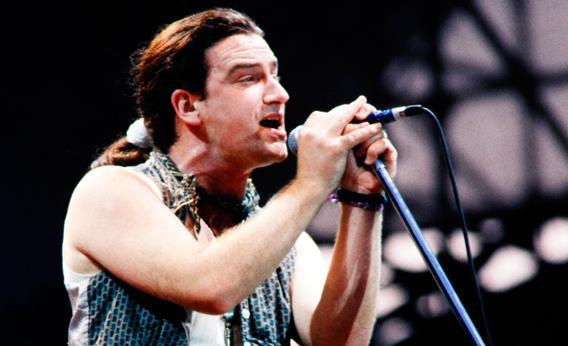
In a piece written for Rolling Stone 20 years ago this month, producer Brian Eno identified why the rock band U2 is singularly enduring and enervating. “Cool,” he wrote, “sums up just about everything U2 isn’t. The band is positive where cool is cynical, involved where it is detached, open where it is evasive.” For 35 years, rock journalists, culture’s self-appointed guardians of cool, have monitored U2’s ups and downs, smash hits and embarrassments. The relationship between critics and the band was fraught from the start, with their anthemic, highly emotive music winning them millions of fans but just as many skeptics. The rock of rebellion and decadence seemed allergic to a band this earnest, emotive, inclusive, politically engaged, and, worst of all, openly Christian. You couldn’t invent a more mock-worthy outfit.
Cool or not, Bono and co. have done quite well for themselves. They’ve sold a gazillion records, have been the no. 1 live act for a few decades, were elected into the Rock and Roll Hall of Fame in their first year of eligibility, and are globally unavoidable—advocating for U2 is like telling someone to pay more attention to Steven Spielberg. This fall marks the 20th anniversary of their best and most important album, Achtung Baby. A remastered, deluxe box set of the album drops this week, and Showtime will debut the Davis Guggenheim documentary From the Sky Down, which revisits that album’s tumultuous recording sessions. With R.E.M. recently giving up the ghost, U2 is basically the last band standing from the Album Oriented Rock era. Inspired by punk but drawn to pomp, suckers for abstract textures but addicted to pop, the band has straddled the realms of art and commerce more audaciously than any other in rock’s history. They’ve sincerely tried to change the world and have strived to remain the best band in the world—differently ambitious, equally dubious pursuits. Yet for the moment, let’s put aside Bono’s blathering public persona—his extra-musical forays into politics, policy, and wraparound-specs addiction—and just talk about the music and its impact on the culture.
In the era of 99 cent downloads, U2 continues to conceive of albums as long-form journeys, with individual songs—like chapters in a novel, scenes in a film, or members of a band—contributing to a greater whole. They’ve always thrived on both consistency and change, applying a surprisingly strict formula to their albums while challenging one another to evolve, adapt, and reinvent their sound. And rather than choose between art and commerce, they’ve almost naively struck a course between the two. Especially today, with music acts either serving the marketplace or accepting their niche, U2 has no peer. I listened to every album, B-side, and soundtrack song, watched every music video, movie, live clip, and costume change. If you’re a fan, let’s compare notes. It you’re not, I’ll tell you what you’ve missed.
Every U2 record begins with a march, and most of them end with a hymn. It’s a formula, but also a moral outlook. Entering with “Onward, Christian Soldiers,” we arrive at “Ave Maria.” From chaos, the band battles to transcendence. The path is consistent, but the ride keeps changing. The marches (“Sunday Bloody Sunday,” “Where the Streets Have No Name,” “Beautiful Day”) are up-tempo, uncertain pursuits through landscapes, forward-leans into the unknown. After peaks, valleys, and digressions, the albums conclude by tilting skyward in nakedly confessional prayer (“40,” “MLK,” “The Wanderer,” “Grace,” “Yahweh”). What changes is the nature of the landscape and the reasons for (and intensity of) the confession.
During the band’s first phase, the Irish-urchins-for-Jesus records, from Boy to October and War, producer Steve Lillywhite presided over a sound that cribbed an itchy urgency from punk and New Wave but forsook anarchic and ironic flair in favor of sincerity and stridency. The very makeup of the band spoke of contradiction: The sturdy proto-punk classicism of drummer Larry Mullen Jr. and bassist Adam Clayton combined with the wide-eyed expressiveness of Bono and the Edge. When they released Boy in 1980, U2 was already a confident, disarming live act and had written dozens of songs from which they culled together a critically lauded debut. But the honeymoon lasted less than a year. You often hear that things turned sour with 1988’s Rattle & Hum or 1997’s Pop (whereas I forgive everything until 2000’s cowardly “comeback,” All That You Can’t Leave Behind), but the backlash actually started back in 1981, with the band’s second record, October. Excitement over a high-energy, high-haired punk outfit from working-class Dublin waned considerably when the band’s up-tempo song cycle about adolescence, Boy, was followed by a similar sounding song cycle about … God. “Oh Lord, loosen my lips,” Bono sang. “I try to speak up, but only in you I’m complete.” Needless to say, nihilistic atheistic Joy Division fans quickly bailed.
Things got only more purposeful and sincere with War, which replaced spiritual preoccupations with political ones, exemplified by one of the greatest protest songs ever recorded, “Sunday Bloody Sunday,” narrating Northern Ireland’s notorious sectarian massacre as a universalized alarm call. Musically, the album was more varied and intentional, with girl group the Coconuts providing key backup vocals, Clayton plucking out funk fills (particularly on “Surrender”), the Edge’s guitar assuming a rougher, serrated aspect, and Bono’s open-throated, max-effort wail smacking of desperation rather than exultation.
Looking to both change course and curry respect, the band recruited ambient rock guru Brian Eno, most famous for presiding over deconstructed masterpieces like David Bowie’s Heroes and the Talking Heads’ Remain in Light, to produce their fourth record, The Unforgettable Fire. The very idea of such an oil-and-water collaboration—overstatement meets understatement, minimalism meets maximalism, left brain mingles with right—equally appalled U2’s label, Island Records, and diehard Eno-philes. It also yielded their first great album. Best known for unleashing “Pride (In the Name of Love)” into the world, the album revealed a band at peace with uncertainty (note the crucial hedge of “A Sort of Homecoming”). The band was turned on by tension, at home in the in-between—the album feels simultaneously ambitious and intimate, determined and digressive, outward and inward. Eno discovered that the kings of anthemic pop were also adventurers, eager to be pushed, pulled, and questioned.
From The Unforgettable Fire forward, U2 has been at its best when Eno, along with studio protégés Daniel Lanois and Flood, have had a strong influence over the recording process—which is not to say that the studio team is responsible for U2’s best work. Eno is a genius at creating and opening sonic spaces, at challenging the listener to hear the familiar differently—thus his soft spot for perverting pop music—which actually suits rather than subverts U2’s strengths. Early videos positioned the band in vast, open-air landscapes—on roofs, floating barges, snow-covered fields—but it wasn’t until The Unforgettable Fire that U2 started to really explore and construct sonic space, layering, modulating, and transporting the listener further and further afield.
Yet after the world-conquering The Joshua Tree—an album that took on and confidently conflated matters of American mythology, Reagan-era foreign policy, spiritual doubt, and sexual obsession—the band dead-ended with Rattle & Hum, a double-album soundtrack to a concert film that attempted to pay homage to roots music but came off as self-aggrandizement. A cooler band would have never allowed its drummer to weep, on camera, at Elvis Presley’s grave or permitted its singer to teach B.B. King how to play guitar. A cooler band would also have surveyed the damage and broken up.
In the end, U2 won for losing. They went on to accomplish what few artists—and very few rock acts—have ever succeeded in doing: wholesale transformation. Influenced by trends in industrial metal, Manchester rave rock, and synthetic soul, 1991’s Achtung Baby ought to have been a spectacular failure. But rather than a desperate bid for cool (Bono’s “Fly” shades aside), the album has the disarming feel of a psychological breakthrough. Recorded in Berlin as that city noisily emerged from the Cold War, the album asserted tentativeness, from the Edge’s spindly, impatient vibrations—every minute he tries on another idea, another gesture—to Bono’s spooky, fragile falsetto. Righteous posturing gives way to twisted love songs and surrealistic similes. On stage the band abandoned bighearted largesse for ironic indulgence, but the pose couldn’t mask the excitable bewilderment of the music. The album’s closing hymn answers “Amazing Grace” in the negative, upending Bono’s (and Christendom’s) favorite metaphor. “Love is blindness,” he insists, cooing and cracking. “I don’t want to see. Won’t you wrap the night around me?”
I find Bono more compelling the further he stands from God—though He’s always within shouting distance. Since the first song on the first album (“I Will Follow”) made an unambiguous promise, the band has been adopted by Christians—U2-themed worship has been a stable of youth services for years—yet the songs themselves rarely fit comfortably into notions of devotion. Even the refrain of their celebrated gospel hymn, “I Still Haven’t Found What I’m Looking For,” admits to restlessness in the face of certainty.
Particularly in the Achtung Baby era, Bono is in constant combat with his faith—challenging, decrying, and equivocating. He assumes the eminently reasonable voice of Judas on “Until the End of the World,” genuflects before a lover in “Mysterious Ways,” and on “Acrobat” sings that he’d “break bread and wine … if there was a church I could receive in.” On the follow-up, Zooropa, an album intended as a quickie EP but that grew into something even more sneakily ambitious than its predecessor, Bono drifts further into doubt. He sings of rejecting God, and yet, somehow, admits, “For the first time, I feel love”; then on “The Wanderer,” the album’s closer, the authoritative voice of vocal guest Johnny Cash acts as a mask for Bono’s confessional lyrics: “I went out there in search of experience, to taste and to touch and to feel as much as a man can before he repents.”
“I think I’d like to give a message to the young people of America,” Bono said while accepting a Grammy for Zooropa. “We shall continue to abuse our position and fuck up the mainstream.” For a few more years, they mainly did. Scattershot anthems for films such as Batman Forever and Goldeneye led to an Eno-presided concept album of songs scored to imaginary movies. Planned as an actual U2 record, Original Soundtracks 1 was eventually released under the no-frills band name of Passengers, ensuring that few would hear the record and marking the moment when U2 stepped back from a precipice of outré experimentation and exhilarating folly. After offering pop radio the unmelodic, Edge-sung drone “Numb” during the summer of ’93, they put Luciano Pavarotti where a guitar solo is supposed to be on “Miss Sarajevo,” the only single from the Passengers record. I can’t speak for the young people of America, but Radiohead was certainly paying attention: A left turn like Kid A doesn’t happen without Achtung Baby and Zooropa. The market had been trained to accept such weirdness. Thankfully Radiohead also learned from U2’s ensuing lack of nerve and has never turned back.
U2’s next official release, 1997’s Pop, was an awkward, insecure, jungle-jam compromise—part hard dance, part soft rock—that finally began to push the band backward. With the turn of the millennium, All That You Can’t Leave Behind slowed their tempo and recirculated old, aging-fan-placating sounds, while Bono peddled ESL-legible, Bobby McFerrin-worthy clichés (“It’s a beautiful day, don’t let it get away,” “Home, that’s where the heart is.”). In stark contrast to his speech seven years earlier, Bono spoke at the 2001 Grammys of “reapplying for … the best-band-in-the-world job.” Like the Rolling Stones, the last band to claim that hubristic and empty title, U2 honed and leveraged their brand as the music itself became less relevant. All That You Can’t Leave Behind and its follow-up, How To Dismantle an Atomic Bomb, are hook-heavy, arena-ready rock machines. They’re all front, emotionally arresting but uncharacteristically depthless. The Edge steals freely from his bag of riffs (“Miracle Drug,” “Crumbs From Your Table”), and the once-mighty rhythm section gets buried deeper and deeper behind Bono’s go-for-broke singing and lyrics that seem eager to please, eager to be at peace with their God and the world. How could the same man who moaned “With or Without You” write a line like “What you don’t have you don’t need it now”?
Promisingly, No Line on the Horizon (2009) was a comparatively messier, more uncertain affair, suggesting that the band might be feeling restless and hungry again (which might be the only reason to forgive Bono and the Edge’s queasily effective experiment in Broadway bombast, Spider-Man: Turn Off the Dark). The problem is how ultimately these records lack everything that makes rock roll, that makes pop crackle, that makes soul. It’s not about coolness—it’s about desire. I can’t get no, you can’t always get, I can’t quit you, I put a spell on you, I still haven’t found, please, please me, why don’t we do it, wouldn’t it be nice, I saw her standing, how could you just leave me standing, burning, desire. At its best, U2 doesn’t merely satisfy our desires, but takes us somewhere, marching into the shadows, exploring spaces within and without, risking failure and greatness, and giving us something worth confessing in the end.
Also in Slate: See the author’s complete ranking of U2’s albums, best to worst.
