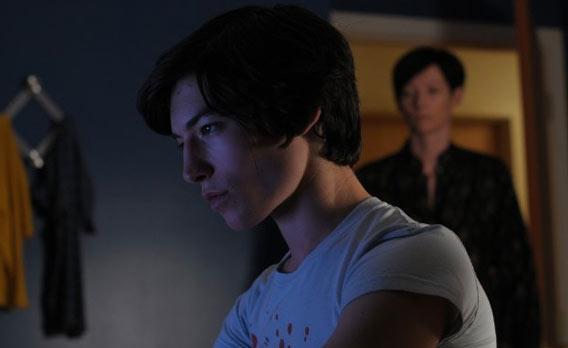
Hypothetical question: What if a parasitic creature is squatting in one’s womb? What if, once born, the baby is a monster—alien and unlovable? What exactly does one do if the darkest and most unspeakable of parental fears come to terrifying fruition? These questions drive one of the classic tropes of horror: the bad seed film. Lynn Ramsay’s We Need To Talk About Kevin, a psychological thriller about the relationship between Eva (Tilda Swinton) and her sociopath son, is the most recent addition to a genre that is both deeply unsettling and confoundingly popular.
In order for a film to legitimately be called a bad seed picture, it must have a strong parent-child element, and the “parent” is almost always the mother. Maternal guilt and culpability is the engine that keeps these films running, and generally, the father is at best haplessly naive and at worst complicit in the child’s misdeeds. And, as opposed to a film like Children of the Corn, in which evil children operate horrifically outside of the bounds of adult control, the bad seed movie gives us little monsters who are, at least nominally, under parental supervision. A viewer prone to identifying with characters in films, even bad horror movies, doesn’t feel sorrow over the death of lil’ Isaac, the crazed killer prophet from Children of the Corn, because his death represents the death of an aberration: a psychotic, parent-killing monster. In the evil spawn films, though, there can be no return to normal—one way or another, the order has been upended, and there is no way for these plots to end in a satisfactory manner for either the child or parent.
The bad seed genre can be divided into three general types:
1. The Perfect Aryan Psychopath. Reflecting cold-war paranoia and fears of genetic pre-determinism and juvenile delinquency, films like The Bad Seed and Village of the Damned present children whose evil is beyond the influence of parents. The Bad Seed gives us Rhoda, an entirely evil little girl in an entirely perfect package. Though she looks like a model of ’50s girlhood, (pressed dresses! blond braids!), she has inherited her grandmother’s “bad seed” and is thus genetically destined to be evil. Her mother still takes the blame, obviously, since there is no real father in the picture (which is also clearly the mother’s fault), and it’s the maternal side’s genes that make Rhoda kill.
Dramatic endings for this kind of movie tend to be kill your child/let your child die. In The Bad Seed, upon finding that little Rhoda is, in fact, a rampaging serial killer, the mother attempts a murder-suicide. Though she succeeds in killing only herself in the novel and play versions, film censors demanded a different ending: Rhoda is struck by lightning while her mother recovers from the suicide attempt. This is supposed to be an ending that reinforces the Hayes Code edict that “crime doesn’t pay”: A mother surviving the death of her child (after trying to kill her) somehow re-rights the status quo.
In The Village of the Damned, the little Aryan children (again, nothing creepier than perfect little blondies!), though born of human women, are really alien spawn. Our hero initially tries to work with the children (stupid liberals, always trying to reform obviously evil children!), but soon realizes that only bombs will do the trick. A more recent example of this type of film is The Good Son, in which Macaulay Culkin appears to be, well, Macaulay Culkin, and is in fact a murdering lil’ psycho. While The Good Son never blames evil genes, it rejects the accepted psychological wisdom. In real life, most violent people come from violent households or have suffered trauma or violence in their formative years. In The Good Son, Culkin lives in a warm, supportive family, instilling in viewers the old bad-seed idea that when a kid is evil, no amount of nurture can undo malevolent nature.
2. Hell-Spawn. In the late ’60s and ’70s, the bad-seed genre saw the advent of the literal hell-spawn picture. In movies like Rosemary’s Baby and The Omen, the child is not really a child at all, but the product of witchcraft, satanic rituals, and/or some very shady baby-making. Aside from reflecting the fears of a tumultuous era that veered toward end-times paranoia, the hell-spawn picture is especially hard on the mother characters, as your options are few when siring Satan Jr.
Essentially, the parents have two endgames in this kind of movie: Die, and let your child do as he will (in The Omen, Gregory Peck is killed before he’s able to kill Damien), or accept that you are Satan’s mother, and get to nursin’! In Rosemary’s Baby, once our poor Rosemary realizes that she has unwittingly birthed the Antichrist, what are her options? Can she really kill her own offspring? No. Can she relinquish all parenting responsibilities to her Satan-worshipping neighbors? No. So Rosemary drops the knife and picks up her baby. She has been used as a human devil incubator, and she is now trapped by motherhood, a prisoner to maternal love and responsibility. The mother is abject before her monstrous child, unable to control, trapped by maternal love and expectations.
3. The monster takes after his mommy. What if that terrible child is not some completely foreign demon, spawned of the underworld? What if the child is recognizably part of you, a being filled with your malevolence, your violence, your anger? And what if you instantly recognize the child as such, and fear and dislike your child? This is the far more chilling premise at work in We Need To Talk About Kevin.
Based on Lionel Shriver’s novel of the same name, We Need To Talk About Kevin is the story of a boy whose mother suspects her child is evil long before he commits the story’s horrific acts. Shriver’s book and the film are both presented from the perspective of the mother, Eva, and posit that Eva’s ambivalence about motherhood may be responsible for Kevin’s malevolence. And so We Need To Talk About Kevin takes maternal anxiety to its most horrific extreme: By being at all unsure about motherhood, one is inviting a sociopath son, a child who will somehow “know” he is not loved enough by his mother, and will by virtue of this, become a monster. It’s all, ultimately, the mother’s fault.
In an interview with Vogue, Swinton said, “It’s everybody’s nightmare that, when they’re pregnant, they’re going to give birth to the devil. That when they bring up children, especially a boy, they’re going to give birth to this violence. … What I find most intriguing about Eva is not that she gives birth to and raises this misanthropic and alienated, sociopathic child and that it’s really foreign and outside of herself. … The thing that’s really the nightmare is that she recognizes it only too well, because its hers. The misanthropy is hers. That violence is hers.”
This kind of film taps not only into modern parental panic about the origins of violence, but manages to perfectly externalize the hyperanalytic guilt of modern motherhood. What if one’s type-A mommying actions are not enough? What if your child can sense your every internal doubt, your momentary frustrations, your guilty yearnings for alone time? And what if that sense leads to your child becoming a psycho? These are fears that most mothers must entertain at some point, but do films that play out these fears succeed in exorcising or simply enforcing them?
We Need To Talk About Kevin presents a far more terrifying premise for parent viewers than the aberrant psychopath or devil spawn child. If your child is an otherworldly monster, as horrific as it may be, it’s not your fault as a parent that your womb was hijacked by the devil. If, on the other hand, your worst characteristics manifest themselves in your child (this concept drives David Cronenberg’s The Brood, in which a traumatized analysand literally spawns killer manifestations of her rage in the form of small blond children), then it’s pretty clearly your problem, mama. There can be no resolutions for these films, as both the psychotic child and the guilty mother are inextricably linked. As Swinton said of Eva, “What’s going to happen to that woman? She’s never going to be intact again, not until she dies.”
And this, ultimately, raises the question: Who is the audience for these movies? As a mother, I have had these nightmares, harbored these fears, and entertained all manner of anxieties, both rational and irrational. So when I’m actually able to find the time to watch a movie, I have no interest in participating in the playing out of these nightmares, as it seems an exercise in masochism. When I was a film student I used to find nothing but derision for people who sought only escapism from film; I wanted to leave the theater challenged and unsettled. Though my insufferability level has lessened considerably in the last decade, I still appreciate film that pushes buttons and challenges, which is why I can, in theory, get behind We Need To Talk About Kevin. Also, the archetype of the selfless mother who is perfectly content to bask in the glow of her child is one that persists in making real mothers feel guilty for their every perceived shortcoming. Bad seed films can be a welcome contrast to this annoying ideal.
But on a pragmatic level, actually sitting down to watch such a film is an exercise in torture. Bad seed films are essentially built on a desire to revel in the abjection of the mother, to dissect the myth of the sacred mother/child relationship, and to deny the kind of easy exorcism of fears that horror allows. If, as Swinton says, these concepts represent every mother’s nightmare, who’s watching them?
In an email, Wheeler Winston Dixon, a film studies professor and author of A History of Horror wrote, “The audience for these films is the same as for the evening news —‘Thank God this didn’t happen to us, but to someone else.’ With Tilda Swinton and John C. Reilly in the mix, We Need To Talk About Kevin will be a much more interesting project than most in the genre, but it still focuses on the fear and dread inherent in having a child; what if things go wrong?”
He continued, “Parents are hardly the target audience for this film, or films like Orphan or The Bad Seed; it’s teens and thrillseekers, mostly in the 18-24 age group, who want to see a violent horror film. As with all horror films, We Need To Talk About Kevin offers us risk without risk, allows us to project and confront our fears without really dealing with them, and offers the reassuring spectacle of the murderous child as someone else’s problem, and not our own. It couldn’t happen to us, right? Or course, it could, but for most, it doesn’t, so why not go to the film and feel reassured that in our own lives, nothing so monstrous could ever happen?”
Ultimately, this is my problem with the genre, and maybe it’s a personal hang-up with horror movies in general. I never feel reassured, never think “this couldn’t happen” to me. As a horror viewer, I’m too open to suggestion, too willing to go completely with the story and identify with even the most outlandish of scenarios. For me, there is never the post-horror-film release—what aficionados liken to roller coasters or even sex—I always imagine what happens after the credits roll. In slasher films, I imagine all the therapy the lone girl survivor will need; in bad seed movies I imagine the lives ruined, the hopes every parent harbors for their child dashed, the pain and guilt and loss. Which is another way of saying that I can’t wait to catch up to the new Muppets movie, and I’m fine with that.
