I never watched an English country-house cook I didn’t love. You know, those salt-of-the-earth types who are forever upbraiding scullery maids and complaining bitterly that the lady of the house has invited the vicar to dinner just minutes before the pheasants are ready to come out of the oven. Cook’s up-do is always messy, her accent broad, and her patience wearing thin. Line her up with a stuffy but kind-hearted butler, a pert but plain-spoken maid, and a handsome, scheming footman, and you’re halfway to a shelf full of Emmys.
American television has its own lovable stock characters, most notably the recovering-alcoholic police captain, the wacky medical examiner, and the eccentric judge. But these TV types are wearing thin; soon they’ll be, like the sassy black friend, a hopeless cliché. (The Good Wife alone is responsible for a half-dozen oddball judges, including a hippie known as “Judge Tie-Dye.”)
Television needs a new utility player, someone who can inspire, provoke, and provide light relief. Several recent series suggest that there might be no better candidate than the pro athlete. Athletes can jerk tears, act like jerks, and clown it up. They’re rich, weird, and needy—the TV trifecta.
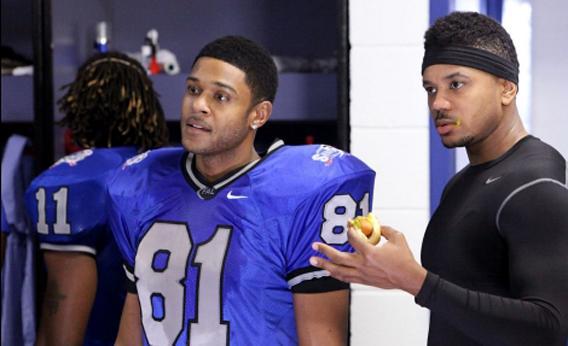
Just this month, USA’s Necessary Roughness, in which a psychotherapist shrinks the oversized heads of the NFL’s New York Hawks, returned for its second season; BET’s The Game, a comedy about the scandalous lives of pro football players and the WAGs who love them, aired its fifth-season finale; and BBC America’s Twenty Twelve, a satirical mockumentary about preparations for the London Olympic Games, is set to debut on June 28. Sometimes fake sports are more popular than the real thing: Last week, The Game, with nearly 2.5 million viewers, and Necessary Roughness, with 3.015 million, both outdrew the potentially decisive Game 4 of the Stanley Cup Finals, which was watched by just 2.07 million people.
The Game exemplifies the benefits of setting a show in the world of sports: You don’t have to worry about world-building or character development, because viewers already know, or think they know, what pro athletes are like. These days, the closest The Game’s gridiron players get to a football field is an occasional visit to the locker room. Instead, they spend most of their time doing what viewers expect of sports superstars: partying excessively, appearing on reality shows, and fathering babies. The storylines write themselves; the creative team just needs to rip tales of juicers, closeted gay players, and cold-hearted executives from the headlines of the sports pages.
By most standards, The Game is a terrible show, with cheap sets, second-rate scripts, and wooden actors, but the series is remarkably watchable because the millionaire players are fascinating characters. In Season 2, when wide receiver Derwin broke up with his girlfriend, quarterback Malik explained what kind of women make suitable dates for men of means. Soon, Derwin found himself at dinner with Janay, who’d already dated Dwyane Wade, Lamar Odom, and Hill Harper—since her family was rich, Derwin and his fellow A-listers could relax, knowing she wasn’t a gold digger. Once I’d seen that episode, I finally understood the Kardashians.
Unlike judges and medical examiners, whose eccentricities must be carefully calibrated if the characters are to remain credible, pro athletes can be as weird as writers want them to be. They’re already humanity’s outliers, capable of physical feats the rest of us pay money to watch, so it makes sense that their neuroses would also be larger than life. Metta World Peace, Dennis Rodman, and acid-dropping pitcher Dock Ellis have already prepared us for every diagnosis.
Being screwed up isn’t the only reason that the men of the New York Hawks make perfect clients for Necessary Roughness’ therapist, Dr. Dani Santino (Callie Thorne). Athletes’ condensed careers mesh well with television’s need to compress complicated stories into 42-minute chunks: “They require immediate intervention,” the show’s co-creator, Craig Shapiro, told me. “If you say, ‘Great, we can work on this for 10 months,’ that’s impossible for a pro athlete. That’s a whole season. Their career is down the toilet by then.”
Setting your show in the world of sports offers writers a wild card. Create a police procedural, and you’re locked into an endless string of murder mysteries. Cast some athletes, and you’re free to try a different genre every week. They’re got workplace issues—this season, Necessary Roughness introduced the Hawks’ reclusive owner, opening up a big can of crazy-boss story lines—and they’ve got drama at home: ABC Family’s recently canceled Make It or Break It, about the lives of would-be Olympic gymnasts, was devastating on the strains that elite training and competition put on family life.
Athletes will get sued, and injured, and some will go to rehab. They’ll betray each other, and bond for life, and they’ll take their shirts off for no reason whatsoever. They’ll sweat, and sacrifice, and best of all for writers, every game brings a chance to write soaring, inspirational speeches.
Of course, adding an athlete is not without its pitfalls. Some viewers refuse to watch sporting action, even if it’s fictional—they’re the people who fast-forward through the Quidditch scenes in Harry Potter movies. You could call this Friday Night Lights Syndrome: As Time explained back in 2007, after seeing the show’s early “testosterone-driven football promos,” many women avoided the show. NBC had to undertake a massive advertising campaign to put out the word that the show was about family, not football. And jocks don’t necessarily attract male eyeballs: Necessary Roughness has a more male-skewing audience than USA’s other original programs, but the difference is just three percentage points.
A sports setting also brings extra production headaches—you can’t cast a 140-pound weakling as a linebacker, and showing an athlete in action requires a lot of extra work, and expense, if it’s to look convincing. For this week’s Necessary Roughness, set in the world of roller derby, Shapiro cast Alicia Ziegler, an actress with a background in bodybuilding and surfing but without much skating experience. Ziegler spent three days with a local roller derby squad; had several sessions with Mark Ellis, the show’s sports coordinator; and was strapped into a special towing rig for her close-ups. Meanwhile, a courtroom set and a black robe is all a legal procedural needs for an authentic trial scene.
Necessary Roughness may have found the perfect way to incorporate athletes into its fictional world without becoming pigeon-holed: It has gradually shifted the focus away from the Hawks’ facility and into Dr. Dani’s consulting room. She has worked with a boxer, a NASCAR driver, a professional poker player, and a golfer, as well as a network news anchor and a media mogul. Despite its title, Necessary Roughness isn’t a football show, it’s a therapy show—it’s just that some of her patients strap on padding when they go to work.
