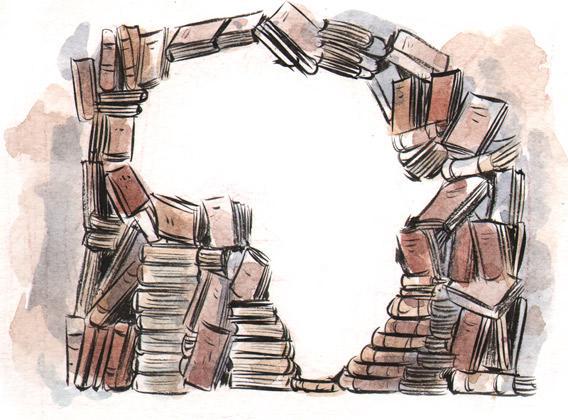
When I was in college, after a discussion of Chinua Achebe at the tail end of a survey course in English literature, I got into an argument with a classmate who suggested that plenty of African literature was good but could never be great because it was so political. Leaving aside the obviously problematic use of “African” as a catch-all classification for literature from 1 billion people in 52 countries (and a decidedly Eurocentric bias), my classmate’s musings did identify a tension at the very root of the Western world’s interaction with so-called African literature. Can literature be both overtly political and also great?
It seems an absurd question when considering many prominent works of the English canon. What is Coriolanus if not a commentary on the life cycles of autocrats? What is Great Expectations if not an extended criticism of class distinction in 19th-century Britain? And yet, with writings by African authors the question persists: Is it high art delivering timeless and universal commentary on the human condition, or is it little more than a guide to the culture and politics of a specific continent (with occasional literary flourishes)? The question will not die because of the Western tendency to view life in Africa as so profoundly alien that nearly everything written from the continent becomes not literature, but a manual—and we all know how we feel about manuals.
The first wave of interest in African writers hit the global literary scene around the same time many countries won independence from oppressive colonial regimes. Beginning in the 1960s, writing from the continent was parsed so thoroughly for political meanings that a sentence was always more than a simple sentence: It was commentary on race, culture, or the politics of colonialism and independence. The stunning craft and beauty of writing by Achebe, Wole Soyinka, and Ngũgĩ wa Thiong’o, for example, was often overlooked; criticism of their work focused in large part on how new Africa presented itself to its former masters—rather than how great writers from a portion of the world presented their many and varied takes on the existential questions that torment us all. African writing was labeled political because Western interest in Africa was, primarily, political.
A generation later, a second wave of interest in African writing arose as the world became reacquainted with Africa as a realm of human suffering—a continent that needed to be saved from itself by the same people who had so thoroughly exploited and rubbished it. Again it seems much of the writing by African authors of the aughts (including my own) was seen as illuminating a very particular form of African misfortune (war, disease, corruption) and not issues that were globally generalizable. In other words, to reinterpret my long-ago classmate’s comment, African literature will never be great in the Western mind not because it is political, but because it is African—and African is too particularly other to be universal.
The Ghanian poet and educator Kojo Laing released his debut novel Search Sweet Country, newly reprinted by McSweeney’s, in 1986—directly between those two eras of international visibility for African writing, a time when once-prestigious universities across the continent fell into disrepair, victims of despots and broken economies. Born in Kumasi, a city well inland from Ghana’s coastal capital Accra, Laing was educated in the U.K., earning a master’s in political science and history at Glasgow before returning to a Ghana completely transformed from a hopeful place post-independence to an economic and political basket case ruled by increasingly aggressive and paranoid military regimes. Gone were the pseudodemocratic Pan-African rhetorical escapades of Kwame Nkrumah, replaced by the numbing military speak (“Operation Keep Right,” “Operation Feed Yourself”) of the generals who overthrew the civilian regime and then each other through the 1970s. It’s those strongmen, particularly Ignatius Acheampong and his successor Fred Akuffo, who most concern Search Sweet Country, a book that for years has confounded those who try to summarize and categorize it. As the Kenyan writer Binyavanga Wainaina writes in his insightful introduction to the rerelease:
When Search Sweet Country was first published it created a lot of critical attention—and confusion. Is it magic realism? No. A satire? No. Panicked critics, constrained by newspaper word counts, by epistemological confusion, by the usual third world head fogs, searched for catchphrases with which to hitch this unruly wagon to a recognizable star.
The closest thing to a plot in this book is the thin thread of happenings after a botched horse-smuggling operation creates a scene at Accra’s international airport. Aside from this, the many, many main characters —the loud and pestering madman Beni Baidoo, the brooding wanderer Kofi Loww, his lover Adwoa Adde, the cantankerous Professor Sackey, his nemesis the scheming academic Dr. Boadi, to name just a few—are free to come and go as they please, telling their stories in a nonchronological fashion, offering bits of wisdom and patent absurdities up to the last page when we wonder, out of confusion and because of our enjoyment, why they stopped. Like Samuel Beckett, Laing utilizes narrative confusion to help construct the book’s environment and emotional tone at any given moment. And as we do with Beckett, we continue reading Laing in spite of our confusion and frustration because of the beauty of his prose. His sentences can only be described as heated, bubbling over with images, slamming metaphor and simile against quiet and simple observation, sometimes purposefully confusing meanings in the most poetic fashion: “The workers stole me right and left, and it wasn’t right that they left me so stolen.” Perhaps it’s the poet in Laing that privileges wordplay over exposition to create both textual wonder and a sense of wondering exactly what we are wondering about.
But however confusing the multiple characters, plots, and even languages of Search Sweet Country, the book zeroes in on what my former classmate might call a particularly African literary shortcoming: politics. Specifically, the politics of identity—or more accurately the search for it—in a world no longer defined by the oppositional forces of the independence era. It is a search that takes place on multiple levels—personal, national, and even international—and in multiple realms: the bedroom, the compound, the farm, the market, the church and streets, in short all the spaces that comprise Laing’s thoroughly and poetically rendered Accra.
“I only want a little authenticity!” shouts Osofo, a Christian priest yet also a practitioner of traditional healing. And it is the authentic identity—“being true to who you already are or would be if it weren’t for distorting influences,” as Laing’s countryman Kwame Anthony Appiah, once wrote—for which both characters and sweet country search.
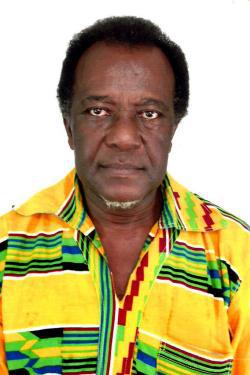
Author Kojo Laing.
Courtesy of the author.
Identity is rooted not just in the traditional practices that cannot be sustained in the modern world, nor in rootless modern practices, but in continuously navigating the narrow space between. Laing’s characters are most terrified of stasis and complacency: “The body of the Ghanian was too heavy, too crowded, and too comfortable: it carried all the symbols, it carried the universe so easily; and in this way, it felt so much less responsibility, so much less adventure for all the external world beyond itself.” Those we might consider this book’s heroes seek constant motion and change as opposed to those, like the notorious Dr. Boadi, who seek material comfort. There is no issue in this book, no issue in the Ghana of the time period Search Sweet Country chronicles that is not pulled into Laing’s vortex of language about the search for an authentic identity. Religion, sex, politics, gender roles, even love are all caught in Laing’s lyrical constructions and turned about for us to examine, appreciate, and also at times loathe.
Reading Search Sweet Country is like reading a dream, and indeed at times it feels like the magical landscapes of writers like the Nigerian Ben Okri or the Mozambican Mia Couto. Each page delivers an intense blast of vivid imagery, a world in which landscapes come to life when inanimate objects receive human characterizations: “Pillars of houses marched to meet and welcome him: There were smiles of baked mud, there were smiles of cement plaster, there were thatched teeth smiling from above, for others came with curiosity from their buildings …” Its political commentary is fascinatingly rooted in the body; fears of impotence and solicitations to the ever-present Ghanaian woman’s buttocks present a people searching for meaning between their own powerlessness and immense (pro)creative potential.
If the characters in this novel are continuously searching, are enamored of change, then too is the book characterized by a disorienting state of flux, sometimes so much so that it seems to lack a cohesive center. Characters appear and disappear. Storylines begin. We are not sure where they end or if they end at all. And at times meaning is lost in a linguistic effusiveness, a poet’s ornamentation, that overshadows the novel’s various happenings. Were Laing not so brilliant in his manipulation of the English language, this might be a greater problem, but thankfully he is a master stylist, and Search Sweet Country delivers an absorbing, if demanding, world for both its characters and the reader.
The McSweeney’s rerelease is itself a physically beautiful book, and it comes at a time when an increased focus on writers from Africa ought to bring Laing more of the recognition that his work briefly received in 1986. The timing of the release also comes as Ghana—and indeed most of the continent—searches for yet another new identity—post-Africa as pity party, prepotential economic explosion (or exploitation, depending on where you stand). Politically Ghana is far from the revolving dictatorships of the 1970s, but it faces new challenges: Managing newly discovered oil wealth and translating the dividends of democracy into development for all of its citizens.
Twenty-six years after its first publication, Search Sweet Country feels fiercely relevant to all individuals and societies grappling with who they are in relation to the wider world. A character’s admonishment that “We are letting our great chance slip in this country. Our war-cry should be to be … historical and to be smart!” is hardly specific to an “African” formulation of identity. Americans and Europeans in particular who seem determined to face a changing world with a desire for more stasis would do well to experience a novel so anti-stasis in content and form.
Because it is so hard to locate, Search Sweet Country is a work that confounds the notion that all things African are somehow too peculiar to apply to the wider world. For sure this is a book about the political upheavals in 1970s Ghana—indeed across the continent at the time—but it is also a book about how any country and its people should approach a fundamentally unstable world. As one character proclaims: “There’s been so much change already in my life that I want more and more! Change everything except the roots that do the changing! And in change we must look both backwards and forwards …” The rerelease of Search Sweet Country takes us in both directions, back to our roots and forward to an unexpected future.
—
Search Sweet Country by Kojo Laing. McSweeney’s Books.
See all the pieces in this month’s Slate Book Review.
Sign up for the Slate Book Review monthly newsletter.
