One hundred fifty people get naked in Times Square. Seven thousand bare it all in Barcelona. Eighteen thousand pose nude in Mexico City. Even if you don’t know Spencer Tunick’s name, chances are you’ve heard about his work. He’s the guy who photographs huge groups of naked people in public places around the world, an art form that has proven to be the ultimate media catnip. Tunick began shooting public nudes in 1992, when he posed a naked man in front of Independence Hall in Philadelphia. Two years later, he was photographing small groups of nude figures on the streets of New York.
Over the years, Tunick’s installations have grown larger and more ambitious, with each new project generating a flurry of news stories, which typically focus on the experiences of the participants, the logistics of the setup, and the sheer spectacle of large-scale public nudity. In addition to all the news coverage, Tunick has been the subject of three HBO documentaries: Naked States (2000), Naked World (2003), and Positively Naked (2005).
And yet, for all the media attention, Tunick’s work has been assiduously ignored by most major art critics. I’ve often wondered why an artist as widely known as Tunick gets so little respect within the contemporary art world. Does the populism of his work make it unworthy of serious critical consideration? Is he a victim of his own media success?
Or could it be the “shtick factor”? Though he varies the settings, the poses, and the number of participants, Tunick essentially repeats the same basic formula over and over again: Find a place, arrange some naked bodies in it, and take some pictures. In 1997, Tunick, trailed by an HBO film crew, photographed naked people in public places in all 50 states. A few years later, he did it again, this time traveling to different countries. So, yes, Tunick has a shtick. Yet the same can be said for countless other artists who have turned their aesthetic obsessions into recognizable signature styles. Just think of Roy Lichtenstein and his Benday dots, or Donald Judd and his steel boxes, or Jenny Holzer and her truisms.
For better or worse, repeating the same idea over and over with minor variations has become standard practice in the contemporary art world. One artist with a shtick that’s strikingly similar to Tunick’s is the Italian-born Vanessa Beecroft, who is known for creating performances in which a number of gorgeous, identical-looking women stand around in a public space (often a gallery or museum lobby), nude or clad in designer bikinis and high heels, looking bored. Beecroft’s work is controversial—some praise it as an expression of post-feminist girl power, others dismiss it as “Hooters for intellectuals”—but either way, she’s considered a major player on the contemporary art scene.
Much of Tunick’s work, like his installation of 770 naked people lining the floor and balconies of the Municipal Theater in Bruges, Belgium, is not so far removed from Beecroft’s in terms of execution. The difference lies in the attitude. Whereas Beecroft cultivates an air of glamour, elitism, and fashionable hauteur, Tunick’s approach is shaggy, populist, and a little bit hokey—more like a hippie be-in than a designer fashion shoot.
Tunick’s public installations of nude bodies come out of a confluence of avant-garde practices that took root in the 1960s as artists tried to move art out of the cloistered spaces of museums and galleries and into the world at large. Among the most important precedents are Allan Kaprow’s early Happenings—performance-art events staged in lofts, parking lots, and abandoned factories, which often demanded the active participation of audience members—as well as the large-scale environmental installations of Christo and Jeanne-Claude, which also depend on the participation of hundreds, and sometimes thousands, of volunteers.
In interviews, Tunick emphasizes his ties to this tradition. “I’m trying to create flesh architecture,” he told the Telegraph recently. “I aim to get a sculptural feel for groups of bodies, as well as create performance art.” Tunick prefers to be seen as an artist, not a photographer. (His manager asked that I refer to his pictures as “documents of installations” rather than as “photographs.”) But the fact is that Tunick’s events are staged almost exclusively for the camera. Rather than secondary documents of performance events, the photographs (sorry!) are the primary point of reference, the ultimate raison d’être of the events themselves.
Tunick recruits models for his mass installations locally through fliers and posters on the streets, as well as through his Web site, where prospective models are asked to register their skin tone on a chart of seven swatches, ranging from petal pink to chocolate brown. Shortly before an event, volunteers receive an e-mail with instructions about place and time (usually around daybreak), and a model release form to print out and sign. A few weeks afterward, every participant receives a small, signed print of one of Tunick’s photographs of that installation.
If you want to know what it’s like to participate in a Tunick installation, you can find hundreds of enthusiastic testimonials at the Spencer Tunick Experience, a Web site maintained by a couple of hard-core Tunick fans. For the most part, participants describe the experience as liberating and exhilarating. People talk about overcoming shame about their bodies and feeling connected to a collective mass of humanity. Tunick’s art is all about cultivating this warm glow of vaguely hippie-ish, utopian collectivity. Yet critically speaking, there’s something about the whole endeavor that strikes me as theatrically self-indulgent. To my eye, it looks like transgression for transgression’s sake.
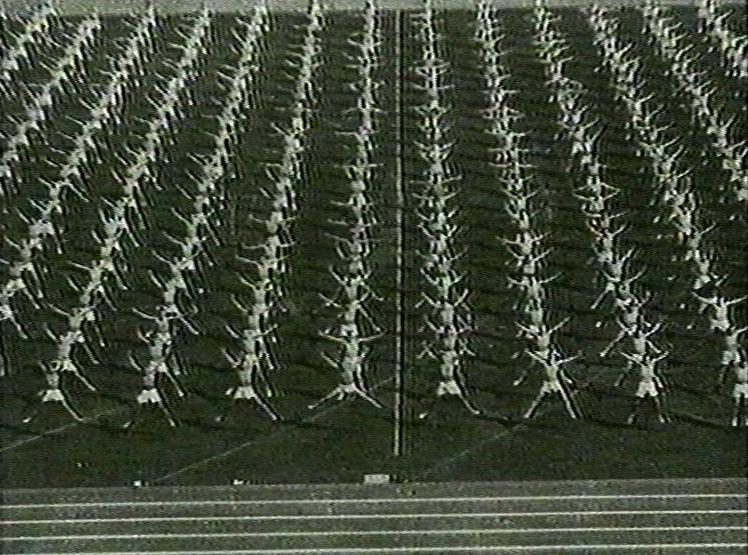
Tunick’s notion of “flesh architecture” comes across most forcefully in his larger installations, like the one in which the naked bodies of 7,000 volunteers blanket the long, open vista of Barcelona’s Plaza de España. While the experience of lying naked on the ground in the center of the city may have sparked feelings of liberation among the participants, the picture itself has a certain regimented quality that brings to mind other famous bird’s-eye views of organized masses, like Leni Riefenstahl’s shots of German athletes performing calisthenics en masse at the 1936 Olympics in Berlin.
Tunick’s larger installations also recall the work of Arthur S. Mole and John D. Thomas, American commercial photographers who traveled to military camps during and shortly after World War I, posing thousands of soldiers to form patriotic symbols like the Stars and Stripes, the Statue of Liberty, and the Marine Corps emblem, and photographing them from above. Like Tunick, Mole and Thomas worked on a massive scale: Their Human Liberty Bell was composed of more than 25,000 soldiers in uniform. While Tunick’s use of public nudity gives his work an air of defiance, the images themselves communicate a message of mass conformity and compliance. Whether or not it’s intentional, this tension between social transgression and collective obedience is one of the more interestingly ambiguous aspects of the work.
Tunick’s largest installation to date took place on May 6, 2007, in Mexico City’s Zócalo Square, where he rounded up 18,000 people and photographed them from the top of a building on the west side of the plaza. Over the course of several hours, he and his assistants herded the group through a number of poses: They stood and saluted, lay down on the ground, crouched in the fetal position, and linked arms to form long rows stretching across the space, as in this image. The effect of so many naked bodies in so large a space is certainly sensational, and Tunick’s Pied Piper-like ability to rally so many individuals to show up so early in the morning and take off their clothes together is truly impressive. And, even though Tunick doesn’t consider himself a photographer, his images are both technically adept and formally striking.
The problem with Tunick as an artist—and the main reason, I think, most critics have ignored him—is that he doesn’t seem to have anything to say. His installations are spectacular and attention-grabbing, but as for what it all means … well, to put it bluntly, I don’t think it extends too far beyond, “Wow. That’s a lot of naked people.”
Over the past few years, Tunick has created a number of commissioned works in support of political causes. Last August, he photographed 600 naked volunteers on the Aletsch Glacier in southern Switzerland, an installation commissioned by Greenpeace to raise awareness about global warming. (The 15-mile-long Aletsch Glacier, the largest in the Alps, shrunk 328 feet from 2005 to 2006.) And in 2004, at the request of Poz magazine, he photographed 85 HIV-positive men and women posing nude in Manhattan’s Florent restaurant to call attention to World AIDS Day. Tunick’s shtick, though conceptually thin on its own, is supremely well-suited for this sort of political publicity stunt. Here, public nudity is invested with real meaning, whether as a symbol of the fragility of the environment or as a visible reminder of the hidden politics of illness.
In other cases, such as a recent commissioned shoot at the Sagamore Hotel in Miami Beach, Fla., Tunick has allowed his art to function as nothing more than upscale advertising. The photographs of this installation, which were exhibited at the Sagamore during the Art Basel Miami contemporary art fair in December, show 500 people cavorting in the hotel’s pool on fluorescent pink and green floats, standing on the hotel’s art deco balconies, and popping open bottles of champagne. They’re all naked. Wow.